


When we talk about the digital shelf, it’s often framed in B2C terms. B2B companies also need to compete online, but they deal with an entirely different audience, a different set of customer challenges, and different buying considerations that make their sales cycle more complex.
“When you say digital shelf, we commonly start imagining the B2C playbook, which in most cases does not work very well for B2B categories,” says Saurabh Sharma, global product lead of client solutions at eClerx, a productized services company that combines people, technology, and domain expertise to drive business results.
Though B2B buyers also expect a frictionless customer experience, multiple stakeholders are typically involved in these buying decisions — each of whom needs very specific, technical information.
To navigate all this complexity, B2B companies need a playbook tailored to their environment. During his session at the 2026 Digital Shelf Summit, Sharma offered a potential one for B2B brands anchored on four key pillars — detect, diagnose, decide, and deploy.
Here’s his B2B playbook that can better position these companies for growth.
B2C vs. B2B: A Different Digital Shelf
In B2C, brands optimize for visibility and discoverability. In B2B, it’s all about accuracy and trust.
“Accuracy plays a massively big role in the B2B space, because if you are inaccurate, you are not just losing visibility; you are going to end up completely getting removed from consideration or the purchase cycle,” Sharma says.

B2B companies also manage significantly more product attributes, technical documentation, and simultaneous buyer personas than their B2C counterparts.
“You are looking to make sure the procurement person who is going to buy the product understands you,” Sharma says. “The technical person who needs to use that product understands this product, that the compliance team understands the product, and so on.”
To add another layer, the rise of agentic commerce only increases the importance of accurate, relevant, and high-quality product content in B2B.
“There are a lot of new digital-first avenues,” Sharma says. “That may be marketplaces expanding to help with B2B buyer penetration, or with product information acting as a key driver for many B2B brands, to ultimately where the customer is making a decision if the product information is either incorrect or insufficient. Obviously, that's being fueled very heavily by AI agents, which we also see coming up in the B2B space.”
Taken together, B2B companies need an effective strategy for creating accurate product data, governing it, and using this asset to commercialize the digital shelf.
A 4-Part Strategy for Commercializing the Digital Shelf
Sharma’s company, eClerx, works with its B2B clients to execute a specific methodology designed to identify content gaps and optimize digital shelf execution.
It involves four key pillars:
-
Detect
-
Diagnose
-
Decide
-
Deploy
1. Detect: Strong Governance and Continuous Monitoring
The first step on the road to commercializing the digital shelf is to proactively detect problems.
This means monitoring more than titles and descriptions. B2B companies also must monitor everything from certifications and technical sheets to country-of-origin information and other data sets that quickly expire or change, Sharma said.
Stronger governance can identify this content before it becomes obsolete or inaccurate, undermines trust, or compromises brand visibility.
During his DSS session, Sharma gave the example of one of eClerx’s clients whose products disappeared from a distributor’s site because its product attributes no longer matched the distributor’s requirements. This led the distributor to deprioritize the manufacturer’s product. A continuous monitoring process for these attributes could have prevented this.
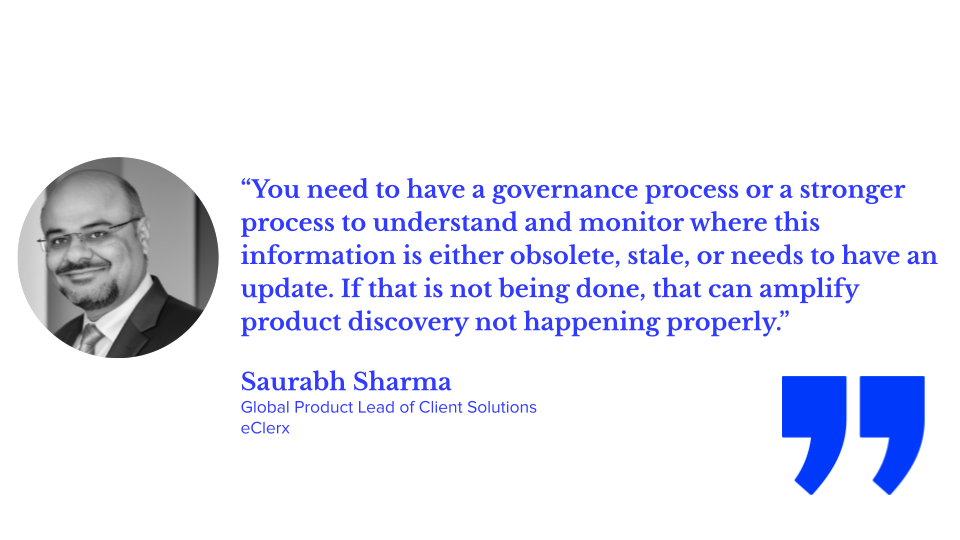
“You need to have a governance process or a stronger process to understand and monitor where this information is either obsolete, stale, or needs to have an update. If that is not being done, that can amplify product discovery not happening properly,” Sharma says, adding that product details also wouldn’t be accurately reflected on the distribution channel, an inconsistency that also hurts buyer trust.
2. Diagnose: Derive From a Single Source of Truth
Next, B2B companies need to diagnose the root cause of an issue.
To do this, they can’t only look at one signal. They have to bring together multiple inputs — across pricing, product content, search performance, distributor content, and inventory — to have a more holistic view of the problem.
“It's not about just knowing where the problem is,” Sharma says. “It’s understanding what is causing the problem.”
He added that the root cause of many digital shelf issues can be traced back to data fragmentation issues, which contribute to inconsistencies that jeopardize accuracy. He gave the example of one of eClerx’s clients thinking that pricing led to its falling conversion rates. However, the real conversion killer was content inconsistencies across distribution channels that no longer reflected the product’s key use cases.
To make product content a growth driver, teams can’t have different versions of truth. They need to create a centralized source of truth using solutions like a product experience management (PXM) platform to optimize digital shelf performance.
3. Decide: Apply Guardrails and Heed Signals
Once a company has detected the problem and diagnosed it, they need to decide how to address it.
However, B2B is a very trust- and relationship-driven industry. Sales often depend on relationships with distributors, resellers, and enterprise customers. Therefore, B2B companies need to create appropriate guardrails and use multiple signals to inform their decisions.
For example, a company deciding on pricing and contract discounts will need to assess different signals, such as historical buying patterns, current inventory levels, existing contracts, and digital shelf performance.
This approach can help minimize risks for both a B2B company and its partners, creating a foundation for properly governed product content changes that improve digital shelf execution.
4. Deploy: Beware of Breakage
Sharma says deployment is the stage where many things break. A company can effectively detect, diagnose, and decide how to fix a problem. However, execution is often the most fraught part of the process.
For example, once a company actually decides to execute a change, their content syndication processes should incorporate validation (both AI-enabled and human-led) to ensure the correct information shows up on the distributor’s or reseller’s site. Without this, syndication errors can delay time to market, visibility, and conversions.
“For a client, we saw there was a huge number of out-of-stock product listings on the distribution channel, and this was more because the pack size or unit level measurement that distributor was following was very different from what the manufacturer was following, so that synchronization caused out-of-stock false messages to appear,” Sharma says, adding that automation can streamline the validation and communication process with partners to avoid these issues.
One company, Ansell, shows the business results B2B companies can generate when they bring these four pillars together to drive their digital shelf strategy.
Ansell: Making Product Content a Strategic Asset
Ansell, a global manufacturer of personal protective equipment (PPE), faced several challenges that compromised its digital shelf performance.
Fragmented systems, manual processes, data duplication, and content inconsistencies prevented the company from properly governing and deploying product content.
It collaborated with Salsify and eClerx to address these challenges. Ansell used the Salsify PXM to build a stronger data foundation, standardizing data models, attributes, formats, and enrichment rules across markets.
This wasn't just a clean-up exercise. It was about building a data culture and a data discipline. eClerx worked with Ansell to help its teams understand best practices, improve data quality, and establish long-term governance — ultimately shifting Ansell’s process from one-off fixes to a sustainable data foundation.
Ansell is now implementing a global approach to monitor content completeness, quality, and competitiveness on distributor platforms.
The company is also defining key performance indicators (KPIs) and benchmarking against competitors to close the loop between content creation and commercial impact.
This will allow Ansell to prioritize improvements based on evidence and continuously optimize its product content where it actually matters most in market — ultimately turning product content into a strategic asset.
Creating a Better B2B Digital Shelf
The B2B digital shelf requires a completely different strategy than B2C.
Because B2B buying and problem-solving are uniquely complex, companies need an airtight operating model for the digital shelf. This means looking beyond the visible storefront to optimize what’s increasingly called the invisible shelf — the backend data and integrations that drive discoverability — and preparing long-term for the rise of the agentic shelf.
The pathway to get there starts and ends with unifying their data ecosystem, creating a centralized source of truth, and establishing a governance-focused system for deploying and validating product content across various distribution channels. Once B2B companies establish this foundation, they will be better positioned for digital shelf success.

2027 Digital Shelf Summit
Get an edge on the latest digital commerce strategies and innovations — join us for the 2027 Digital Shelf Summit, April 26–28, in Orlando, FL.
REGISTER NOW.svg)
