

AI and ecommerce are a natural fit. Emerging agentic tools excel at collecting data from disparate sources, while ecommerce sales depend on omnichannel marketing across multiple digital touchpoints.
To help consumers find what they’re looking for, and point them in the direction of products they don’t even know they want — yet — companies like Amazon and OpenAI have developed ecommerce shopping agents.
These agents can collect and correlate data from brands’ product catalogs, public customer reviews, Q&As, social media posts, and third-party posts, allowing them to create curated answers to customer queries about the best product for “X” application, the highest-quality item in “Y” category, or the most cost-effective choice among “Z” options.
According to Salsify’s “2026 Consumer Research” report, 21% of customers say they would use these agents regularly, and 41% say they’re somewhat interested in using agents for routine purchases.
And, in Salsify’s upcoming “2026 Holiday Pulse Report” launching in June, 51% of shoppers say they feel comfortable with agentic commerce.
%20for%20routine%20purchases.png?width=960&height=384&name=41%25%20of%20shoppers%20are%20somewhat%20interested%20in%20using%20ecommerce%20agents%20(agentic%20commerce)%20for%20routine%20purchases.png)
For retailers, the rise of conversational ecommerce agents offers an opportunity to surface more product content to more customers, more quickly — if they can dominate the conversation.
Here’s how to get them talking and keep them focused on your brand.
What Are AI-Powered Shopping Agents? (With Examples)
AI-powered shopping agents help customers find what they’re looking for. Using a combination of large language models (LLMs), natural language processing (NLP), and generative AI (GenAI), prospective buyers can ask questions in plain language and get personalized results.
What sets this apart from a typical product search is agents’ ability to extrapolate. Customers don’t need to provide specifics. Instead, they can provide a general idea of the features, functions, and price points they’re looking for, and then let AI do the heavy lifting.
Companies such as Macy’s, Amazon, and OpenAI have all deployed AI shopping agents — with varying degrees of success.
Macy’s AI Agent
As noted by Retail Dive, Macy’s officially released their “AI conversational shopping assistant” on March 23, 2026. Before widespread deployment, it was released as a small-scale “dark launch” — results from the tool’s beta test period show that revenue per visit was 4.75 times higher for customers who used Ask Macy’s.
Amazon’s Rufus
Ecommerce and Amazon are old friends. Amazon Rufus deepens this relationship and is on track to add nearly $10 billion in annualized sales for the company.
The Drum reports that on Black Friday in 2025, Rufus “captured approximately 40% of total user sessions but drove roughly 66% of purchases.”
Given Amazon’s massive product catalog, Rufus' success makes sense; if customers can access high-quality outputs tailored to their queries, they’re more likely to move from consideration to conversion.
OpenAI’s Agent
For OpenAI, however, the move to AI shopping hasn’t gone so well, according to The Tech Buzz.
When the company rolled out its Instant Checkout feature, which enabled purchases from brands including Etsy, Walmart, and Shopify, item information was frequently incorrect, and inventory data lagged behind actual availability.
OpenAI’s issues provide perspective; while it’s important to consider the growing role of ecommerce agents, companies can’t afford to ignore other paths to purchase, such as generative engine optimization (GEO), answer engine optimization (AEO), and the development of omnichannel digital shelf strategies.
Why Brands Should Ensure Agents Are Talking About Them
Brands enjoy several benefits when they’re part of the customer/agent conversation.
Improved Engagement and Satisfaction
First is improved engagement and satisfaction. The easier it is for consumers to find what they’re looking for and compare potential product options, the more likely they are to make a purchase and come back for more. In addition, agents help filter out the “noise” of multiple product pages, each filled with descriptions, reviews, pricing, and policies.
Streamlined Purchasing Processes
Next are streamlined purchasing processes. Although OpenAI fell short, this technology is still in its infancy, meaning there’s plenty of room for improvement. Brands must be prepared for a near-future scenario in which customers can query AI, compare multiple products, and make a purchase, all from a single chat window.
Boosted Loyalty
Finally, brands can boost loyalty. Macy’s is a good example. With many classic department stores struggling to stay relevant in an online-first world, leveraging AI agents is a great way for brands to stay current without straying from their core mission.
3 Tips To Capture the Ecommerce Conversation
Capturing the ecommerce conversation doesn’t happen by accident. Instead, it requires a concerted effort on the part of product, marketing, and sales teams to ensure the right content is in the right place at the right time.
Here are three tips to get agents talking about your brand.
1. Prioritize Value, Not Volume
“There’s no such thing as bad publicity.” While this was probably true for P.T. Barnum’s circus act, it doesn’t hold up in ecommerce:
-
In a best-case scenario, negative customer service experiences and product reviews will cause your brand to be overlooked by shopping agents.
-
In the worst-case, agents will return this data to prospective customers as part of a comparison with other, more desirable options.
To effectively dominate ecommerce conversations, companies need to prioritize value.
Think of it like the shift from keyword stuffing to contextually relevant search results: While articles and websites stuffed full of keywords clawed their way to search engine results page (SERP) top spots, they didn’t offer any value for users.
Moving to a value-based model increased the applicability of search results and changed the way companies structure their content.
The same is true for AI-powered shopping agents. While repeated mentions of your product or brand across websites and social media platforms can capture agents’ attention, these tools are also smart enough to leverage context.
If it becomes apparent that you’ve prioritized quantity over quality, you won’t be part of the conversation.
2. Get Your Content House in Order
Ecommerce agents will only talk about your brand if they can find reliable and accurate content.
For example, if you’re selling on Amazon, you need to ensure that your product pages, pricing, and availability information are up-to-date and are designed with AEO and GEO best practices in mind, so Rufus will pull and display your content.
Make sure your content is clear, concise, and accurate. Use keywords that resonate with your audience, but don’t overstuff — in much the same way that GEO crawlers for search engines look for pages with content authority, Rufus and other ecommerce agents want consistency.
3. Take Trust Seriously
Just 14% of shoppers trust AI recommendations alone to make a purchase, and 27% say that while they trust AI for some purchases, they verify with other sources. The primary driver of trust? Detailed product descriptions and specifications.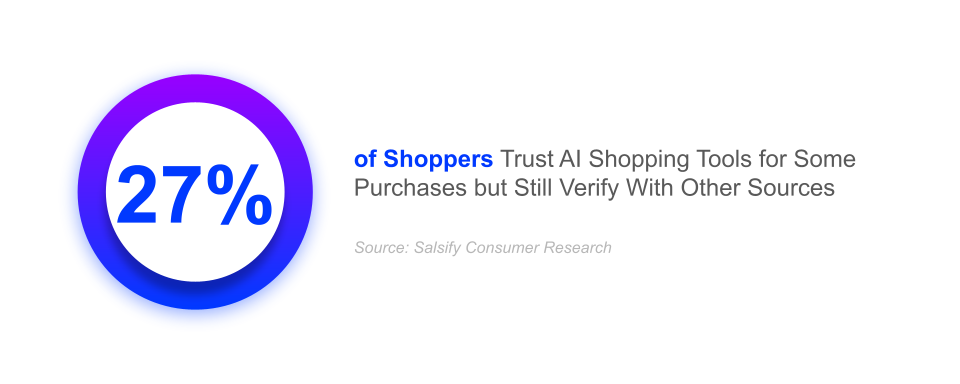 Other trust components include accurate pricing, delivery, and availability information, along with clear return and refund policies.
When it comes to ecommerce agents, trust makes or breaks the conversation. If AI identifies data discrepancies or consumers report differences between online assurances and product realities, agents will simply stop bringing up your brand.
Can You Hear Me Now?
Agentic commerce is changing the way customers find, compare, and purchase products. Conversational AI tools enable companies to go beyond question-and-answer to deliver relevant and real-time results.
For brands, this makes being part of ecommerce agent conversations a top priority. By getting these tools talking about what sets your product apart from the competition, brands are better prepared to capture customer interest, increase conversion rates, and keep consumers coming back.

WATCH ON-DEMAND WEBINARS
Unlock your AI ecommerce potential with Salsify’s on-demand webinars.
GET STARTED HERE.svg)
