

AI search is supposed to make shopping easier: Ask a question, get an answer, and move on with your life.
That was the technology’s promise, and in some ways, it’s largely delivered. Type "best wireless headphones under $100" into an AI search tool and you'll get a ranked answer in seconds — no clicking through 14 tabs, no affiliate blog posts, or eye-rollable Reddit threads.
But a majority of shoppers are merely using AI tools to start their journeys, not to end them. And they’re still deep in the weeds when it comes to researching their purchases, consulting a wide range of channels before making their ultimate decision.
What does that mean for online brands? AI is a tool, but not yet the end-all, be-all — at best, AI is just another channel influencing discovery, and not seen as one that “closes the deal.” More accurately, shoppers are treating it like a smart friend who gives reliable recommendations: useful, but not the last word.
Brands that understand this won't just chase AI visibility; they'll make sure they hold up everywhere a skeptical shopper goes to double-check your brand claims.
How Shopper Behavior Around AI Search Is Changing
Though AI has earned its place in the research mix, earning shoppers’ trust is another story.
For example, while adoption is growing, it remains mostly limited in scope. Only 22% of shoppers use AI tools for shopping, and just 14% fully trust them to guide a purchase. Another 27% say they trust AI, but still go elsewhere to verify what it tells them, according to Salsify’s “2026 Consumer Research” report.
At the same time, it is starting to reshape the research stack itself. AI tools (22%) are now used more often than traditional sources like product review sites (19%) and online forums (14%), giving shoppers a faster way to get oriented before diving deeper elsewhere.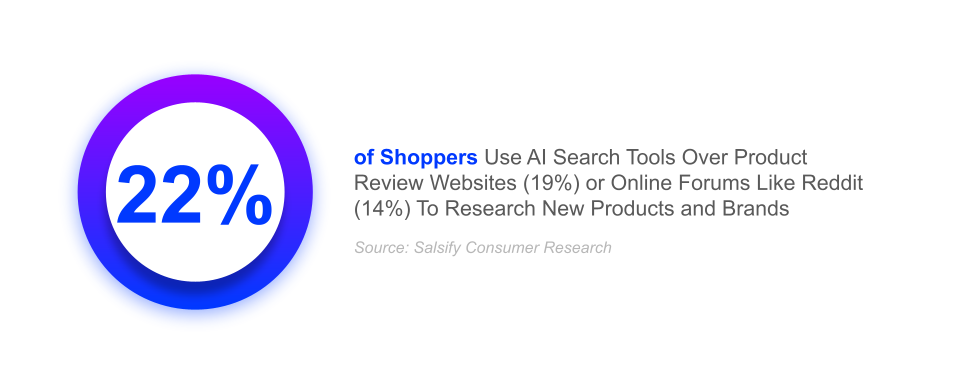
More than half (56%) of U.S. shoppers now use four or more channels before making a major purchase. AI may add another step to that process — but it doesn’t replace the others. Detailed specs (31%), personalized explanations (25%), and reviews or ratings (25%) are what ultimately determine whether that answer holds up.
The result is a more deliberate, less impulsive shopping process. AI helps narrow the field, but shoppers still validate across multiple sources before committing.
3 Ways How Brands and Retailers Should Respond
The instinct is to chase AI visibility — optimize for the algorithm and get cited in answers — is understandable. But it’s really only part of an effective AI strategy. Here are a few best practices that research suggests can actually move the needle.
1. Build for Comparison, Not Just Visibility
AI search doesn't just surface products; it evaluates them, too. One report — AthenaHQ’s “State of AI Search 2026” — found that 41% of AI-generated responses cited informational content, while 27% was comparative. As a result, "Best X vs. Y" beats "our product is great" every time, because that's the format AI is pulling from, and shoppers are searching for.
If your content isn't built to answer the question "How does this stack up?" you’ll be missing out on AI discovery opportunities.
2. Get Your Product Content Right — Everywhere
That same report found that AI pulls from an average of nine to 16 sources per response. The top cited include Reddit, YouTube, and Amazon — i.e., not just your website.
In other words: If you're only optimizing your owned pages, you're invisible to a significant chunk of the AI ecosystem before a shopper even gets to verify your claims.
And when they do verify, bad product data can be a serious dealbreaker — among younger shoppers, 55% said they’ve returned an item due to bad product data, according to Salsify consumer research.
3. Make Your Content Earn Trust, Not Just Attention
Shoppers trust AI recommendations most when they're backed by detailed specs, real reviews, and explanations that feel relevant to them — not generic marketing copy. Getting surfaced in an AI answer is only valuable if what the shopper finds when they dig deeper actually holds up.
From Discovery to Trust
AI is accelerating discovery. It’s not, however, closing the trust gap on its own. That’s your brand’s job.
While shoppers are finding products faster than ever, they’re still relying on marketplaces, reviews, and real-world experience before they commit. That behavior isn't going away; if anything, as AI surfaces more options more quickly, it will only accelerate.
The brands that win in this environment won't be the ones who figured out how to game an AI answer. They'll be the ones who show up in that answer and hold up everywhere a skeptical shopper goes next.
Even in the age of AI, the same principles for a successful omnichannel strategy ring true: Meet your customers where they are, with the information they need, and they’ll reward you for it.


Guide: Becoming an AI Leader
Interested in learning more about how brands can stay at the forefront of AI innovation? Check out the guide for ways these tools can create compelling product experiences for your customers.
DOWNLOAD NOW.svg)
