


Today’s search engines are fielding questions about your brand, your products, your return policy, and a range of other details — often before customers ever visit your website, if they do at all.
As AI-generated answers on search engines become increasingly common, even world-class brands will need to grapple with the fact that they are, more than ever, represented by platforms outside of their direct control.
For customers, this is often a no-brainer: AI-generated answers can reduce friction, surface relevant information quickly, and help shoppers move along the journey with confidence. AI’s tendency to “fill in the blanks” when it doesn’t know the right answer, however, can cause some real headaches for brands.
AI systems are most likely to hallucinate when they’re forced to work from incomplete, inconsistent, or poorly structured information. Answer engine optimization (AEO) addresses that gap by extending ecommerce optimization beyond mere discoverability alone, and into the ways AI systems interpret and represent your products.
SEO, GEO, and Now AEO: How Ecommerce Optimization Is Expanding
With AI-generated answers becoming a new staple of the search experience, it’s understandable why some might assume that traditional optimization strategies no longer apply.
But that’s not exactly the case. For example, market research from Gartner suggests that most product searches still follow a mixed, hybrid path to finding answers.
While AI-powered summaries are visible to many consumers, Gartner’s findings suggest they don’t rely on them exclusively. In fact, more than two-thirds of users continue searching beyond AI overviews during product research, and only about a third say generative AI (GenAI) actually rivals traditional search engines for learning new information. In other words, AI answers appear to supplement, rather than outright replace, traditional search behavior.
According to Salsify’s “2026 Consumer Research” report, just 22% of shoppers use AI search tools (e.g., ChatGPT, Gemini) to research new products and brands. (The majority (60%) do so in physical retail stores.)
%20to%20research%20new%20products%20and%20brands.png?width=960&height=384&name=22%25%20of%20shoppers%20use%20ai%20search%20tools%20(e.g.%2c%20chatgpt%2c%20gemini)%20to%20research%20new%20products%20and%20brands.png)
Is AEO Replacing SEO? What Brands Should Focus on Amidst AI Expansion
A TechBullion interview with Rob Gonzalez, Salsify co-founder and chief innovation officer, examined why “AI shopping keeps hitting a wall” and the risks brands face if they don’t adapt to AI as “a common starting point” for shoppers on the digital shelf.
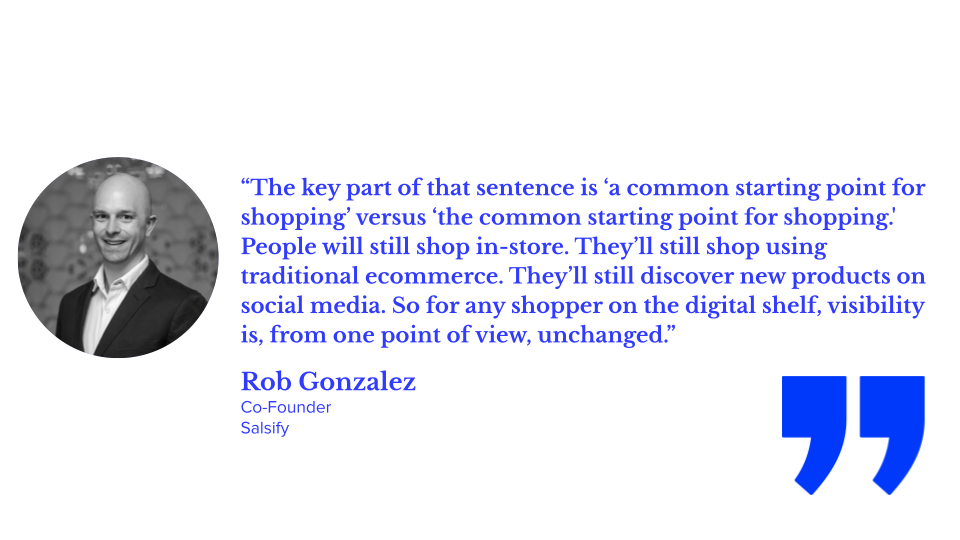
Gonzalez continues by saying that visibility is key on the agentic shelf, and he’s skeptical it’ll be used for a large volume of transactions anytime soon.
Even amid relentless enthusiasm about AI, SEO, and GEO continue to play a critical role in ensuring content can be found and trusted in the first place. AEO simply extends those same principles into how information is organized, interpreted, and surfaced when AI systems generate answers directly within the search experience.
So no, AEO doesn’t replace SEO or GEO. It builds on them, helping ecommerce brands ensure the content they already invest in remains accurate and reliable when search shifts from ranking pages to answering questions.
How Content Continues To Drive Discovery
Luckily, the same fundamentals that support strong ecommerce performance across SEO and GEO also shape how AI systems interpret and surface content.
Both traditional search engines and answer engines rely on similar signals, including:
-
Authority;
-
Clear structure; and
-
Meaningful relationships between topics.
That’s why content quality and organization matter more than volume. Fragmented, ad hoc publishing weakens visibility across both rankings and AI-generated answers.
In contrast, brands that organize content around clear topic clusters — and reinforce them through consistent internal linking and semantic formatting — give discovery systems the signals they need to rank and respond with confidence.
The same principle applies to product data. Complete, accurate, and consistently structured attributes don’t just improve on-site experiences. They also reduce the likelihood that AI systems will infer or fabricate missing details. Clear answers to common shopper questions, standardized naming, and well-labeled comparisons make information easier for machines to interpret and reuse.
The payoff is broader visibility across all discovery surfaces, whether customers are scanning search results, evaluating product pages, or reading AI-generated summaries.
3 Steps Ecommerce Brands Should Take To Prepare for Answer Engine Optimization
Preparing for AEO isn’t about predicting which AI platforms will matter most next year — it’s about ensuring the content and data you already rely on are accurate, structured, and interpretable.
1. Conduct a Content Audit
For most brands, the first step is a content audit focused on accuracy and structure. That includes assessing whether existing assets clearly answer common shopper questions, use consistent terminology, and are organized in ways both people and machines can navigate.
Gartner specifically recommends mapping content to intent and buying activity streams, rather than relying on keyword coverage alone.
“OpenAI’s public data feed, for example, has fields like ‘Intended Purpose / Role’ and ‘Event Context / Use Case,’ which is not information that is typically stored and used in traditional ecommerce,” Gonzalez shares. “This information is unstructured text and is about describing a product’s contextual relevance in the world … [It] gives us strong hints as to what information matters, and it’s the contextual data: when is the product used, what it is used with, what is it used for, what is it used instead of, etc.”
2. Put Up (or Perfect) Some Pillars
Organization matters more than volume. Persona-led pillar pages supported by interlinked topic clusters give search engines and answer engines the hierarchy they need to establish authority and extract information reliably. This kind of approach improves passage-level extraction and reduces the likelihood that AI systems will infer or fabricate missing details when responding to user queries.
Brands should apply the same rigor to product data. Complete, consistently structured attributes, standardized naming conventions, and clearly labeled comparisons make product information easier for AI to interpret — and safer to surface at scale.
Additionally, consumers consider AI product recommendations the most trustworthy (and worth buying) if detailed product descriptions and specifications are provided, according to Salsify’s latest consumer research.

Image Source: 2026 Salsify Consumer Research
3. Continue Tracking
Finally, preparation requires ongoing monitoring. Gartner advises tracking proxy AEO signals such as brand mentions, citation rates, and how often content is referenced or summarized by AI tools.
Observing how AI systems describe your products, policies, and differentiators can reveal gaps in structure or clarity long before they become customer-facing issues.
AEO as the Next Evolution of Ecommerce Optimization
AEO isn’t a departure from established ecommerce optimization — it’s a continuation of it. Built on strong SEO, structured content, and accurate product data, AEO helps ensure those same investments hold up as AI systems play a larger role in how information is surfaced and summarized.
As such, brands don’t need to wait for fully agentic commerce to get started. Strengthening content quality, structure, and governance today makes it easier for AI systems to represent products accurately across search, summaries, and emerging discovery experiences.
Seen in this light, it might be helpful to regard AEO not as “chasing what’s next,” but more about extending what already works in an AI-mediated world.

On-Demand Webinar: AI Path to Purchase
Want a closer look at how AI is fundamentally reshaping the path to purchase? Check out Salsify’s “AI Path to Purchase: The Next 5 Years Starts Now” webinar for expert insights on what’s coming next.
WATCH NOW.svg)
