


Believe it or not, when it comes to their digital shelf capabilities, most brands barely get a passing grade.
That’s the perspective of Gregor Murray, co-founder and chief strategy officer at Digital Commerce Global (DCG), a leading digital commerce intelligence platform.
“Most manufacturers are stalled on the digital shelf and don’t know it,” says Murray, whose company benchmarks brands and works with companies around the world to help them understand their digital commerce capabilities.
Murray led a session at the 2026 Digital Shelf Summit (DSS), “Commerce in 2026: The Capabilities That Deliver Market-Leading Growth,” covering how brands can advance their digital shelf maturity. Here’s his view on what it’ll take.
The Current State of Digital Commerce Capabilities
From retail media and data to AI-driven product data management, Murray says most manufacturers have invested in building their digital commerce capabilities.
However, certain capabilities have now become table stakes. Nearly every brand worth its salt has created a similar foundation. However, many have ramped up their digital commerce capabilities but haven’t seen the payoff in better performance.
“We've done the basics,” Murray says. “We've moved on.”
When it comes to advancing their digital shelf maturity, Murray said agility is what mostly separates the leaders from the laggards.
“I hear manufacturers saying to me that they're growing in digital commerce, but actually in many cases, they're losing share to faster, more agile competitors,” he says. “The leaders are accelerating their capability significantly faster than the average [company], and that is paying dividends for them.”
Murray didn’t just present a hypothesis — his perspective was grounded in evidence.
DCG conducted research in which it asked brand manufacturers to answer a series of questions and then scored their capabilities based on their responses.
DCG then used these insights to develop a framework called SEEK — Strategy, Enablers, Execution, and Culture — that identifies 45 core digital commerce capabilities it believes create a world-class digital commerce organization.
DCG’s research potentially illuminates the way forward for brands, framing what gaps they must close and where they need to invest to drive digital commerce growth.
What Digital Commerce Leaders Do Better
In DCG’s study, the average U.S. manufacturer scored 253 out of 400. However, digital commerce capabilities leaders scored an average of 291 out of 400.
“These are the manufacturers that are truly excelling when it comes to digital commerce,” Murray says. “Starting out, there was a 25-point gap between average and the leaders [in previous studies]. It's now up to 38 [point gap].”
Leaders are growing 8% faster, on average, than their peers. Every five points of incremental capability translates to 1% faster growth every year, Murray added.
In this environment, strategy is no longer a critical differentiator. DCG found that the difference between a leading company’s strategy capability and the average company’s strategy capability is negligible.
“Events, promotions, retailer understanding, content optimization, search optimization, portfolio, digital shelf strategy — these are not the capabilities driving leading growth for those leading manufacturers,” Murray says. “If you score low for any of these things, yes, you absolutely have to gain the ground, but these are the table stakes of digital commerce.”
Instead, what separates leaders is that they excel in these four key areas:
-
Ways of working
-
Prioritization
-
Senior leader understanding
-
Partner utilization
“These are the capabilities where the gulf between the leaders and the average [companies] is significant,” Murray says.
The 2026 Digital Commerce Capabilities That Drive Growth
Leading companies have established a strong operational foundation that gives them a clear market advantage. They’re aligned internally and externally, and this alignment is reflected across the four key operational areas that drive digital commerce growth.
1. Ways of Working
This core capability focuses on cross-functional collaboration and internal processes. Murray describes ways of working as “how problems” rather than “what problems.”
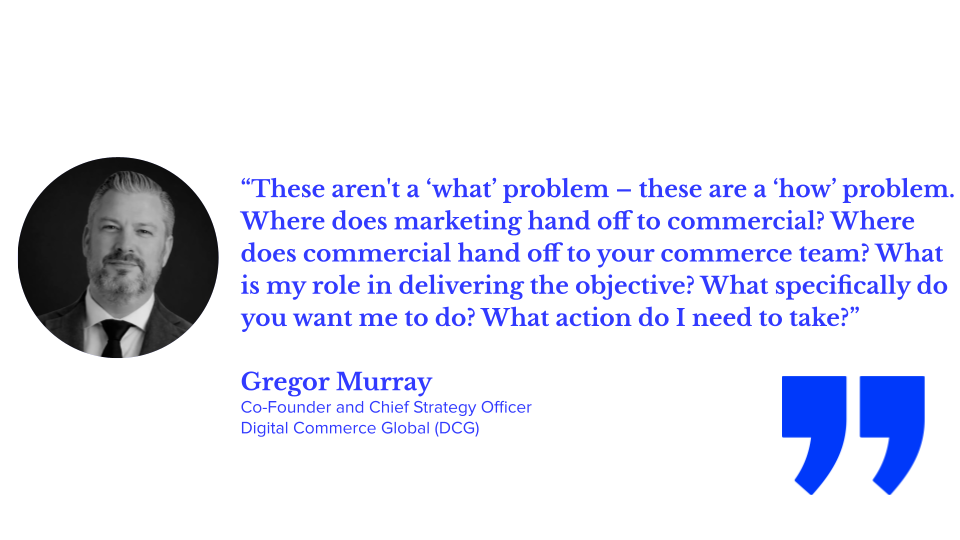
Murray says companies need to thoroughly evaluate how they currently work before making significant AI investments.
“Doesn't matter how much money you spend on AI, all you're going to do is make the same mistakes faster,” Murray says.
2. Prioritization
Leading companies have an effective game plan for growing their digital commerce capabilities: They focus on low-hanging fruit, yet high-impact use cases.
“Every workshop that I do, somebody will say to me at some point, ‘What's the low-hanging fruit? What are the actions that we can take now? What are the quick wins that we can do right now that are going to accelerate our growth?’” Murray says. “This is the strawberries of low-hanging fruit. This is fruit hanging so low you have to bend over to pick it.”
These things are largely quick internal wins that build buy-in and unlock huge growth. For example, it may use AI to surface exceptions or errors when a team member is mapping content to new retailer channels, or to suggest content changes for product detail pages that could increase conversions.
Leading companies don’t chase every opportunity; instead, they’re focused on opportunities that drive visible, tangible impact.
3. Senior Leader Understanding
When senior leaders truly understand the digital shelf, they buy in.
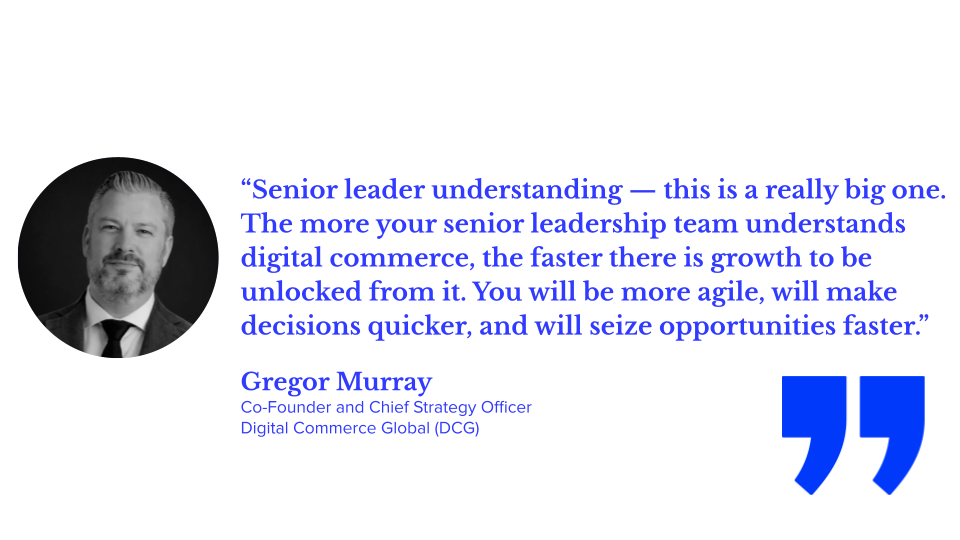
But in 2026, that buy-in has to go deeper than just approving a budget for basic generative AI (GenAI) tools. To scale operations, leaders must understand the core shift from GenAI to agentic AI in digital commerce — because while generative tools only write content, agentic AI can actually execute complex operational workflows on autopilot.
When leadership buys in, that often leads to more investment and that capability becoming a key operational priority.
A leadership team that grasps the shift to agentic AI can greenlight smarter, faster investments. They move from treating ecommerce AI as a novelty to making it a core, revenue-generating priority.
4. Partner Utilization
Lastly, leading companies understand they can’t go it alone to build their digital commerce capabilities. Partners are vital for advancing their maturity.
“There is more growth to be unlocked from roles and responsibilities, prioritization, ways of working and processes, and utilizing your partners better,” Murray says, specifically calling out digital, data, and creative agencies, as well as Salsify and The Digital Shelf Institute (DSI) as partners.
“Working closer with them, having them challenge you, having them push you, there is more growth to be unlocked from working closer with your partners,” he says.
Digital Shelf Experts: Who Leads in Digital Commerce Capabilities?
As we merge into the agentic shelf — sometimes called the invisible shelf — the rules of retail are changing. This is an environment where autonomous AI agents, not human eyes, browse, compare, and purchase products behind the scenes. If your product data isn't clean and structured for machines, your brand simply disappears from this shelf.
Several brands have mastered the four capabilities listed above. Voted on by their peers, the top three brands are:
-
L’Oreal
-
Nestlé
-
The Coca-Cola Company
All three consumer packaged goods (CPG) companies not only were early digital commerce adopters, but they’ve also developed a comprehensive digital shelf strategy.
“They’re all taking a really holistic approach to digital commerce,” Murray says. “They've looked at capabilities they need to build — all of the ones that are going to help them build a competitive advantage. They’re looking at their ways of working, they're looking at their processes, and they're looking at how they can build a truly world-class digital commerce business consistently across their markets, across all of the categories that they work in.”
L’Oréal, Nestlé, and The Coca-Cola Company serve as models for brands. Here’s a plan for how their peers can similarly mature their digital commerce capabilities.
How To Unlock Digital Commerce Growth in 2026
DCG’s research showcases what it will take to drive digital commerce growth in 2026 and beyond.
Companies that want to build a durable competitive advantage must be effective operators, skilled at internal change management, have a plan to build sustained leadership buy-in, and engage skilled partners to execute smarter and faster.
In the case of Groupe SEB USA, a small appliance manufacturer, AI was both part of their challenge and their solution.
The team struggled with a “very inefficient” and “very painful” alt text creation process, according to content operations lead Juliana Yepes.
“[However,] the alt text process is so important because we need to ensure we meet the ADA compliance regulations and provide a great shopping experience for all of our customers,” Yepes says.
Not only that, alt text feeds agents crucial data about product images: When content is clear, accurate, and complete, it’s more likely that Groupe SEB’s listings will be served to users.
The team’s entire alt text process, even for a large batch of 50–100 images, now takes about five minutes — down from more than two hours — with high-quality text generated in seconds thanks to Salsify’s Intelligence Suite, an AI-powered workbench designed to automate product experience management (PXM) processes while keeping humans in the loop.
With significant time savings, Yepes shared that their team can focus on higher-value work, such as incremental process optimization, eliminating redundancies, and aligning their work with Groupe SEB’s overall business strategy.
Brands, Don’t Stand in Your Own Way
“When it comes to digital commerce, your biggest barrier to growth is you,” Murray says.
He added that companies that are trailing behind need to ask themselves these pressing questions: “Where are you spending time that the leaders aren’t? Where aren’t you spending time that the leaders are?”
The answers to these questions may point the way toward digital shelf excellence and digital commerce growth for brands.

2027 Digital Shelf Summit
Learn more about the future of digital commerce at the 2027 Digital Shelf Summit in sunny Orlando, FL — register today.
REGISTER NOW.svg)
