


Ecommerce is growing fast, but the way people shop is changing even quicker. Global ecommerce sales are expected to hit $6.88 trillion this year, accounting for 21.1% of total retail sales, according to eMarketer. In other words, online shopping isn’t slowing down anytime soon.
The biggest change is how shoppers decide what to buy. Consumers are becoming more thoughtful and selective about their purchases, with many shopping online less frequently and taking more time to compare products and read reviews before hitting buy.
At the same time, the path to purchase is becoming increasingly convoluted. A shopper might find a product in a brick-and-mortar store, research it on a marketplace like Amazon, “try it on” via augmented reality (AR), check social media for opinions, and even ask AI for recommendations before making a decision.
With all this in mind, it makes sense that the biggest consumer trends in 2026 focus on understanding how shoppers move across channels and what gives them the confidence to choose one brand over another.
1. AI Is Reshaping Product Discovery and Research
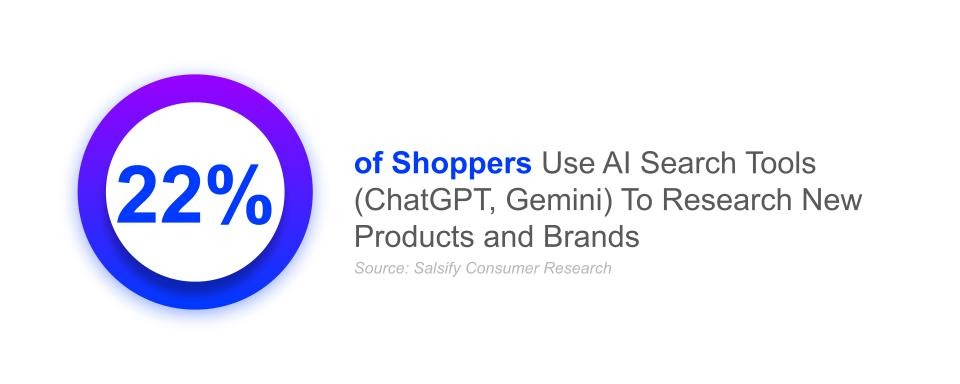
AI has officially entered the chat. Tools like ChatGPT, Gemini, and other AI-powered search assistants now play a huge role in how people research products and compare options. In fact, according to Salsify’s “2026 Consumer Research” report, 22% of shoppers say they already use AI search tools to research new products and brands.
But while people are curious about using AI to shop, they don’t blindly trust it. Most shoppers treat AI recommendations as a starting point, with only 14% saying they fully trust AI-generated recommendations enough to make a purchase right away.
For brands, this is a clear sign that winning an AI recommendation from an AI tool isn’t enough on its own. It’s just another step in the journey. To take advantage of it, treat product content as a connected ecosystem, making it easy for both AI tools and human shoppers to understand exactly what they’re buying.
2. Answer Engine Optimization (AEO) Adds a New Layer to SEO
As AI becomes part of the shopping journey, it’s also changing how people find products online. For years, most brands focused on search engine optimization (SEO) to rank in Google results. Now, there’s a new layer to think about: answer engine optimization (AEO).
Instead of simply listing search results, AI tools aim to generate direct answers and recommendations. That means they rely heavily on structured, trustworthy content to understand products and explain them clearly to shoppers.
For brands, this changes what effective product content looks like. You can’t just include a short description and hope for the best. To do their job properly, product pages need to include richer, more detailed information that both shoppers and AI systems can interpret.
That might include things like:
- FAQs that answer common customer questions
- Detailed specifications and product attributes
- Customer reviews and ratings
- Contextual descriptions that explain how and why someone might use the product
This type of content also helps shoppers feel confident in their purchase decisions. In fact, 31% of shoppers say detailed product descriptions and specifications make them trust AI-generated product recommendations enough to buy.
3. Agentic Commerce Is Emerging, But Adoption Is Uneven
As in-store shopping happens on the physical shelf, ecommerce happens on the digital shelf — agentic commerce happens on the agentic shelf.
Agentic commerce is another concept gaining attention in ecommerce. In simple terms, this refers to AI-powered shopping agents that can discover products, compare options, and even complete purchases automatically based on a shopper’s preferences.
Imagine telling an AI assistant you need a new pair of running shoes, and it goes off to research the best options, compares prices, reads reviews, and places the order for you.
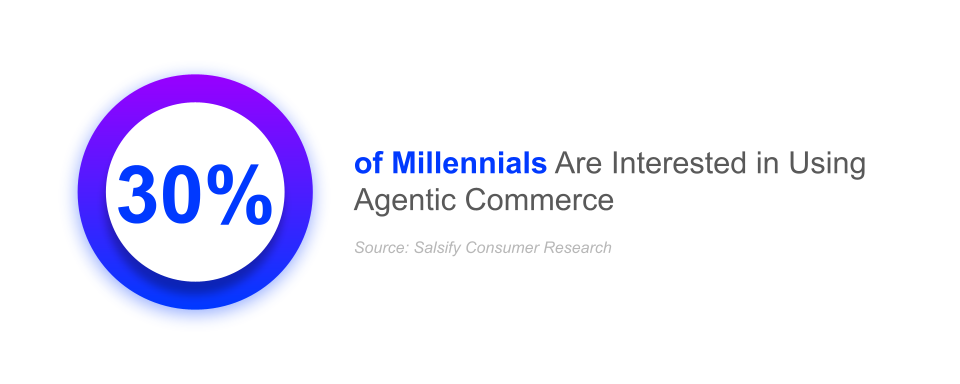
Some shoppers find this very appealing for the convenience and time saved. But enthusiasm for AI shopping agents varies quite a bit by generation. According to Salsify’s consumer research, 30% of millennials and 26% of Gen Z shoppers say they’re interested in using AI agents for shopping, while interest drops sharply among older shoppers. Only 5% of baby boomers say the idea appeals to them.
The hesitation mostly comes down to two things: trust and control. Many shoppers aren’t ready to let an AI system buy something on their behalf. They still want to compare options themselves and feel confident about the final choice.
There’s a good chance AI-assisted shopping will become more common over time, rather than replace human shoppers entirely. You can prepare by making sure product content is rich and accurate across channels.
4. Online Marketplaces Are the Primary Product Research Channel
Most shoppers go straight to online marketplaces when they want to learn more about a product. Platforms like Amazon are now the default place to research products and compare options. In fact, 51% of shoppers say they use online marketplaces to research products and brands.
It’s easy to see why. Marketplaces make research really easy. Shoppers can quickly scan product reviews and compare multiple brands side-by-side. Most marketplaces also surface helpful information that builds trust, like ratings and user photos. Instead of tabbing between multiple websites, shoppers can get a complete picture of a product in just a few minutes.
This means your marketplace listing is often the first impression shoppers have of your product, so treat it like a full product experience with clear descriptions, detailed specifications, and plenty of reviews.
5. Physical Retail Stores Are Still the Top Discovery Channel
Despite online marketplaces ranking number one for research, good old physical stores are still the top spot for discovering new products.
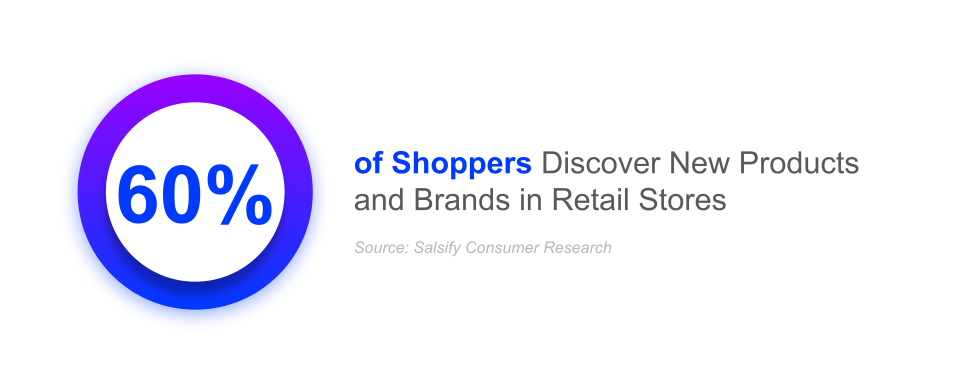
According to the consumer research report, 60% of shoppers say they primarily discover new brands and products in retail stores.
A big part of this comes down to the experience. In-store shopping lets people touch, test, and see products up close in a way that just can’t be replicated online. It also encourages casual browsing. Shoppers will often walk into a store looking for one thing and leave with something completely different.
For brands, this trend reinforces an important point: Ecommerce doesn’t exist in isolation. Today’s shoppers move fluidly between physical and digital channels. They discover products in-store, research them online, and sometimes purchase through a completely different channel.
6. Consumers Are Shopping Online Less Frequently
Another crucial shift happening in ecommerce right now is how often people shop online. Yes, ecommerce sales overall are on the up, but shoppers themselves are becoming more deliberate about when and what they buy.
Salsify’s consumer research report found that daily online shopping has fallen from 21% of shoppers to just 9% year over year. That’s a significant drop. Instead of shopping every day or several times a week, more people are spacing out their purchases.
This shift inevitably means fewer impulse purchases. Instead of reflexively hitting the buy now button, shoppers will often explore several brands, check marketplace listings, and sometimes even visit physical stores before deciding.
The competition is basically moving further up the funnel. You need to show up earlier in the research phase instead of just winning the moment of purchase. To do this, you absolutely need strong product content, helpful reviews, detailed specs, and clear comparisons.
7. Price Sensitivity Is Driving Brand Switching
The knock-on effect of a turbulent economy is that shoppers aren’t (or can’t be) as loyal to brands as they were, simply because of price. Today, shoppers are more willing to explore alternatives if they find a better deal. In fact, 72% of shoppers say they’ve purchased from a new brand instead of their usual go-to brand within the past year, according to research from Salsify and the Digital Shelf Institute (DSI).
That’s a pretty clear signal that consumers are keeping their options open.
And when shoppers do switch brands, the reason is often straightforward: price. Fifty-five percent of shoppers say they chose a different brand because it offered a better price or promotion.
This creates a delicate balancing act. Competitive pricing is important, but constantly lowering prices isn’t always the best long-term strategy. Instead, you need to combine fair pricing with clear differentiation, aka showing shoppers why your product is worth choosing.
8. Secondhand Shopping and ‘Dupe Culture’ Are Growing
Another knock-on effect of the fragile economy is that shoppers are getting more creative about how they find value. More consumers are turning to resale platforms and secondhand marketplaces to stretch their spending. Twenty percent of shoppers say they’re buying secondhand products more often than before.
For some, it’s a way to save money. For others, it’s a chance to reduce waste and be more sustainable. Either way, resale is becoming a much more mainstream part of the shopping ecosystem.
At the same time, social media has fueled the rise of “dupes” (basically, cheaper alternatives to popular or luxury products). According to the consumer research report, 16% of shoppers say they’ve purchased a dupe version of a viral or luxury product after seeing it online.
This makes differentiation more important than ever. When it’s really easy to find cheap alternatives, you need to clearly communicate what makes your products worth the extra investment. Often, this boils down to quality, craftsmanship, innovation, and a decent, relatable brand story.
9. Product Experience Management (PXM) Is Becoming Essential
Perhaps the biggest challenge for brands in this new, complex ecommerce space is managing product information across dozens of channels. Products are now scattered across marketplaces, retailer websites, brand sites, social platforms, and AI tools, and each one needs accurate, up-to-date content.
This is precisely why product experience management (PXM) will be huge in 2026. PXM platforms help you centralize and manage product info in one place, so you can easily distribute it across every channel where shoppers might find you. Because it’s all stored in one single system, you don’t have to manually update product descriptions, images, specs, and attributes across multiple platforms.
PXM also makes it much easier to personalize the shopping experience and take advantage of AI’s new role in the journey. Rich, structured product data helps AI tools understand products better and lets brands easily tailor product content to different audiences and channels.
What To Expect in 2026
Ecommerce in 2026 is shaped by three big forces: AI-driven shopping experiences, more selective consumers, and the continued rise of omnichannel commerce.
AI tools are changing how people discover and research products. Shoppers are using more channels than ever to compare options. And at the same time, economic pressures are making people more thoughtful about what they buy and which brands they trust. Together, these shifts are redefining what it takes to stand out on the digital shelf.
For brands, success will depend on adapting to this new reality. The key will be making sure your product information is accurate and consistent everywhere shoppers look and embracing new discovery channels powered by AI — all while continuing to invest in the fundamentals that build trust, like strong product content, authentic reviews, and transparent information.


2026 Consumer Research Report
Explore Salsify’s consumer research to dive into the latest trends across the buying journey, including what drives loyalty or dissuades trust.
DOWNLOAD NOW.svg)
