

Though millennials are largely the progeny of baby boomers, they don’t necessarily have the same viewpoints — especially when it comes to technology.
Millennials were raised in the age of coding their own Myspace pages and frequenting chatbots like AOL’s SmarterChild. As technology matured (rapidly), millennials grew in lockstep.
Boomers, conversely, remember an age before the personal computer. So, it’s no surprise that millennials and boomers are at opposite ends of the AI adoption spectrum.
Salsify’s “2026 Consumer Research” report reinforces these AI mindsets: More than 20% of millennials say they “trust and use AI shopping tools regularly, while 55% of baby boomers don’t use them at all.” Gen Z and Gen X align more closely with millennials, but each generation has its own approach.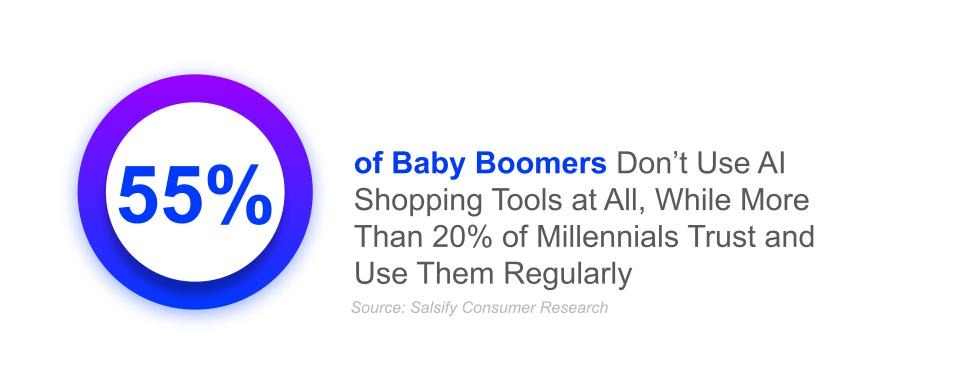
Here’s a breakdown of millennial and baby boomer AI adoption behaviors, with tips for winning over even the most AI-resistant shoppers.
Millennials vs. Baby Boomers: Their Stances on AI Adoption
Here’s how each generation approaches AI usage in the workplace, as well as in their buying journeys.
AI Usage in the Workplace
According to Salsify’s consumer research, 27% of respondents trust AI shopping tools for some purchases, but still require verification from other sources.
This sentiment also applies to the workplace. There’s an AI trust gap within the workplace — while some are excited about the benefits of AI, others aren’t as willing to adapt for various reasons.
Millennials, however, are “emerging as the surprise AI power user at work,” according to a survey conducted by Slack, a Salesforce company.
This survey reveals that millennials' enthusiasm is even stronger than younger generations: “30% of millennials say they thoroughly understand AI agents — edging out even Gen Z (22%).”
According to SurveyMonkey, boomers are more comfortable with AI as a form of entertainment than in the workplace (though they often fall for deepfakes). This could be related to the fact that many are at retirement age and don’t encounter AI productivity tools as often.
Global Economic Impact on Shopping Behaviors
Economic pressures and global trade policies have provided shoppers with a combination of higher prices and fewer options. This impact has led 39% of shoppers to compare prices more carefully, and has resulted in a sharp decline in daily spending, according to Salsify research.
Sixty percent of millennials, however, still shop online at least once a week and feel comfortable using AI tools to aid in their shopping decisions.
Agentic Commerce and the Buying Journey
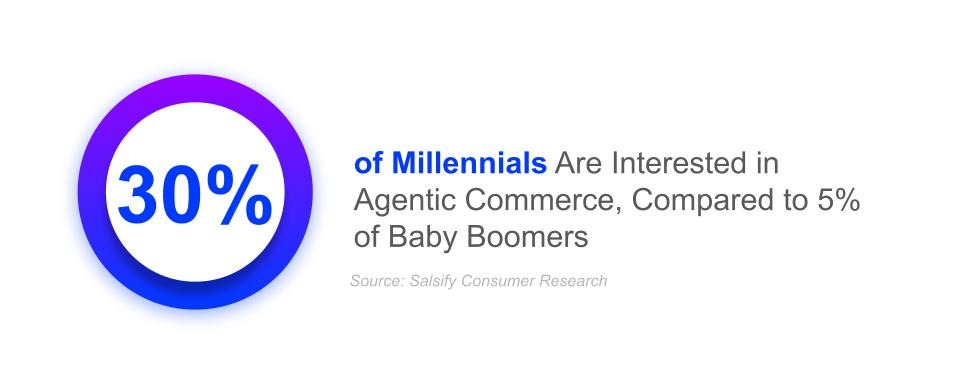
Agentic commerce, or the use of AI agents as personal shoppers, is the perfect example of the generational AI divide. Thirty percent of millennials are interested in using agentic commerce, whereas only 5% of boomers feel the same, according to Salsify consumer research.
Agentic commerce appeals to millennials because:
- 41% trust AI tools, believing these tools know more than they do and are impartial.
- 40% love the convenience of shopping any time.
- 38% like the time-saving aspect.
Baby boomers, on the other hand, place less importance on these reasons, and nearly half (48%) cite a lack of trust as a major barrier to use. An equal number say they dislike the lack of control in their shopping experience.
How Shopping Experiences Can Sway AI-Resistant Shoppers
Despite their different AI stances, millennials and baby boomers definitely agree that high-quality shopping experiences are paramount for brand trust.
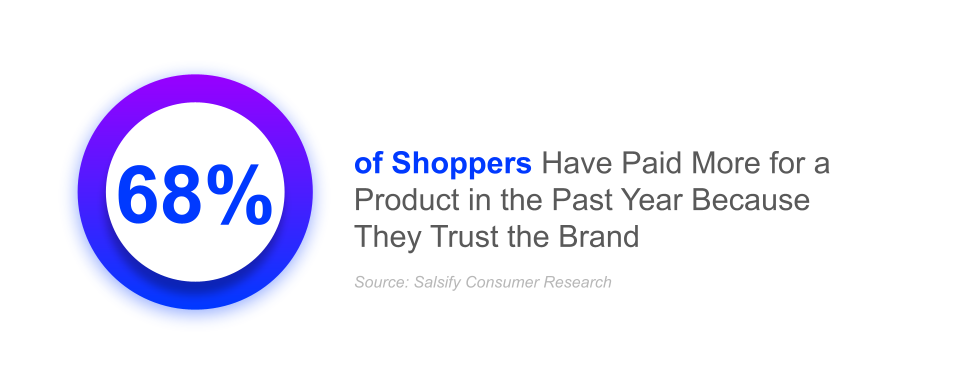
Salsify research shows that 68% of shoppers paid more for a product within the last year because of brand trust. Better yet, 78% of surveyed millennials say brand trust influenced their spending on a product; nearly half (48%) of boomers say the same.
High-quality product content — a crucial part of brand trust — sways 49% of millennials and 33% of boomers.
Shoppers view these factors as indicators of high-quality product content:
- Durability and longevity (54%);
- Positive customer reviews and ratings (47%); and
- Brand reputation and history (45%).
Other important elements include pricing and availability, which are the most important product page elements to a whopping 76% of boomers. If prices are too high, 58% of boomers and 39% of millennials will abandon carts.
Shoppers will be more likely to purchase based on AI recommendations if they trust the recommended brands — or if they receive detailed product descriptions and specifications (31%).
Cater To Each Generation’s AI Needs
Millennials are already paving the way as AI superusers; cater to their needs by creating integrated campaigns that help you build a strong, unified cross-platform presence.
Boomers will take more convincing, but you can win them over with experiences that build trust.
While it still may take some time for AI-resistant shoppers to warm up to the idea of AI, you can help speed up the process with high-quality shopping experiences and transparency.

2026 Consumer Research
Download Salsify’s latest consumer research for more insights into millennial and boomer buying behaviors.
DOWNLOAD REPORT.svg)
