

Deepfakes are realistic pieces of content, such as videos, audio, or text, that have been generated or manipulated by AI.
They were first used as a vehicle for identity fraud and have since proliferated “fake news” on social media sites. Seemingly real videos or images of politicians or celebrities doing and saying things they have never done or said are now commonplace, making it harder than ever for users to separate fact from fiction.
Deepfakes are also making their way into commercial operations through fake product reviews and advertisements. If what consumers see and hear seems real enough, they may be convinced to purchase poor-quality or low-value items.
As noted by Forbes, this carries a range of consequences for companies, including “the erosion of public trust, economic damage, reputational crises, panic, and flawed decision-making.”
While it’s impossible to prevent the spread of deepfakes, there are ways for brands to reduce the risk of damaging consumer trust.
‘Trust Me, Bro’? (How AI Impacts Consumer Perception)
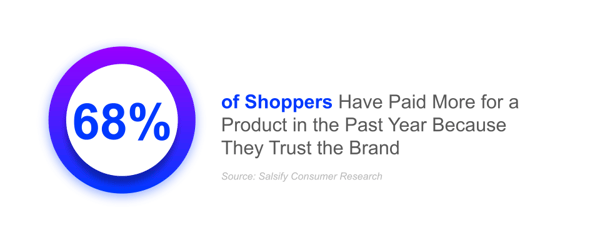
Consumer trust is essential for brand success. According to Salsify’s “2026 Consumer Research” report, 68% of buyers are willing to pay more for products from brands they trust.
Trust is also part of a larger shift in customer priorities. As noted by Deloitte, 40% of consumer perceptions of value are tied to elements other than price. Trust is one of these elements — building trust encourages confidence in brand relationships and sets the stage for return business.
Losing trust, meanwhile, comes with consequences. Research from Boston Consulting Group (BCG) found that 30% of large companies have experienced a major loss of customer trust. The firm describes the process of regaining this trust as “slow and difficult.”
AI Tools Can Affect Consumer Trust
The increasing use of AI in product search, descriptions, and customer service can also make or break consumer trust.
Salsify research found that:
- 33% of buyers don’t use AI shopping tools;
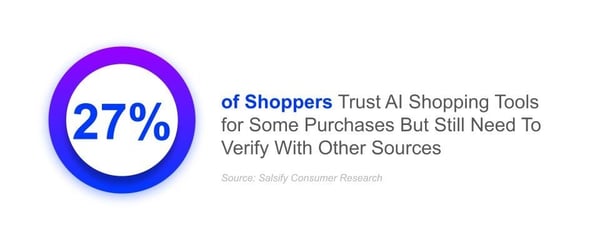
- 27% use them but verify with other sources; and
- 6% don’t use them at all.
Just 14% say they trust and use these tools regularly. However, if these AI tools provide detailed product descriptions and specifications, 31% of shoppers are willing to take the risk and make the purchase.
This is where deepfakes become problematic: AI search tools and agentic shopping can miss the telltale signs of fake ads and reviews, in turn leading consumers to purchase poor-quality or low-value items.
The result? Trust is toast.
Fake It ‘til You Make It: The Rise of Brand Deepfakes
Brand deepfakes can take several forms. The most common are fake reviews. These deepfakes are often the hardest to spot, since reviews can be created and posted by anyone, anywhere — even if companies don’t allow user-generated reviews on website product pages, fakers can post their content on public forums or social media.
Some of these deepfakes come from bought-and-paid-for “bots” that are simply low-level AI algorithms designed to spit out hundreds or thousands of reviews. Others are more bespoke, using sophisticated models to create near-perfect review fakes.
In most cases, these reviews have solid grammar and sentence structure and include enough personal details that they appear to originate from a real person. They may also include small errors to help build the illusion of legitimacy.
Deepfake AI tools are also a consideration. As noted by research published in the Journal of Technology and Systems, deepfake-as-a-service (DFaaS) providers are now emerging, which provide synthetic media to any user for a price.
Spot the Difference Between Malicious Fakes and Authentic Uses of AI
Fake ads are another deceptive pathway. Using commercially available software, malicious actors can create realistic-looking ads for products or services that include inaccurate descriptions or pricing, or suggest an affiliation with specific social groups to provoke a negative or positive online reaction.
According to research from the Tech Transparency Project (TTP), more than 150,000 deepfake ads were run on Facebook last year, often targeting seniors.
Brands themselves also play a role in the deepfake uptick as they increasingly rely on AI-generated media to reduce advertising costs. While there’s nothing wrong with leveraging AI for advertising, taking this approach makes it difficult for consumers to spot the difference between authorized and malicious fakes.
Addressing the Deepfake Dilemma: 4 Tips To Keep Consumer Trust
So how can brands address the deepfake dilemma? Here are four tips to help keep consumer trust.
1. Building Better SEO and GEO
Search engine optimization (SEO) and generative engine optimization (GEO) both play a role in combating deepfakes. If brands can establish an authoritative, high-ranking presence on popular search engines, consumers are more likely to use this content as the benchmark for trustworthiness and reliability, and discard outliers from other sources.
2. Control Your Content
Content control means ensuring that real content is produced in specific formats and distributed over specific channels. Consistency in creation and distribution makes it easier to spot deepfakes when they happen, and to clearly show customers where deepfakes don’t measure up.
3. Prioritize Transparency
As noted above, many brands now use AI-generated content to improve marketing efforts and reduce total costs.
According to an article published in the Journal of Advertising Research, “When disclosed, high-quality deepfake advertisements influence advertising outcomes such as purchase intention, eWOM [electronic word of mouth] intention, and behavioral engagement, via an emotion-value appraisal chain.”
In other words, great deepfakes help drive sales conversions — but only if they are fully disclosed as AI-generated. Transparency is key to building customer trust.
4. Take Action Immediately
When deepfake reviews or ads are found, brands need to take action immediately. Staying quiet only extends the reach and impact of fake content.
Start with a strong rebuttal published in the same format as the deepfake. Call out inconsistencies and errors, and point customers to your official webpages and ecommerce platforms for verification.
What You Don’t Know Can Hurt You
Deepfakes aren’t going anywhere, and that’s a problem for brands. UNESCO describes the proliferation of these fakes as a "crisis of knowing.” What happens when seeing and hearing can no longer be confidently tied to believing?
For businesses, controlling the narrative is key. By building better SEO and GEO, controlling content assets, ensuring ad transparency, and taking immediate action if deepfakes are spotted, brands can establish themselves as the go-to source of reliable, relevant, and real information.

2026 Consumer Research Insights
Take the lead on building and maintaining consumer trust with data from Salsify’s “2026 Consumer Research” report.
DOWNLOAD NOW.svg)
