

It's understandable if a mention of AI can bring either a heavy sigh or a sigh of relief, depending on context. What's obvious is that if it's not being actively spoken about, it's lying in wait, probably the next topic on the docket for just about every department meeting from IT to legal, customer success to sales, to marketing, product, and ecommerce, to C-suites and boards.
Knowing how and when to leverage AI within your specific industry — and finding the precious time to test and learn — may be the hardest step.
Fortunately, there are ecommerce innovators we can turn to for insights on how to build an effective ecommerce AI strategy. Explore the basics of AI in ecommerce, gain insights into how shoppers and brands use AI, and see real-world examples to ignite your planning.
What Is AI in Ecommerce?
Within ecommerce, artificial intelligence is used externally with shoppers to enhance the buying journey and internally at organizations to automate processes and optimize operations.
Machine learning (ML), natural language processing (NLP), generative AI (GenAI), AI agents, and computer vision are the most commonly used AI technologies within ecommerce.
How Is AI in Ecommerce Used Shoppers? By Businesses?
For shoppers, AI shopping assistants, chatbots, and agents can help build next-level shopping experiences, allowing for personalization at scale and real-time responses — anytime, anywhere.
Salsify’s “2026 Consumer Research” report found that at least 22% of shoppers purchased a product in the past year because it was recommended by an AI search tool or shopping assistant.
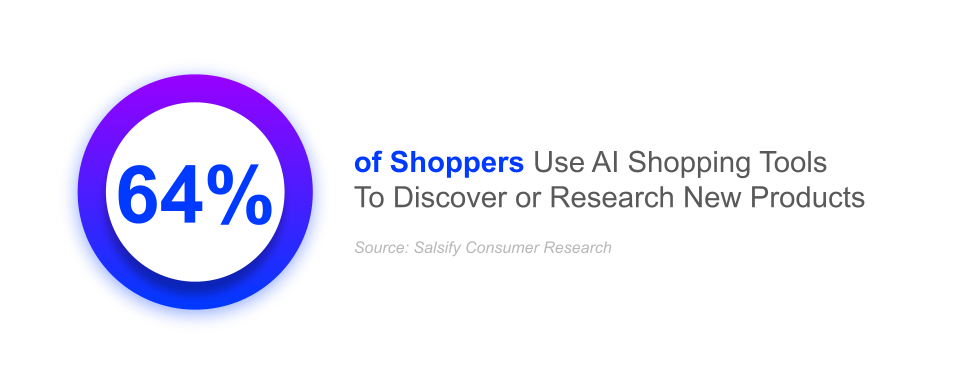
And even more are leaning into AI shopping assistants for product search: 64% of shoppers use AI shopping tools to discover or research new products, including 79% of Gen Zers, 77% of millennials, 60% of Gen Xers, and 36% of baby boomers, according to Salsify's "Ecommerce Pulse Report: Q4 2025."
For organizations, AI can help automate processes, such as repetitive actions like updating properties, sending messages, and publishing to channels — which can offer exceptional time-saving benefits for teams. It can also help optimize operations like pricing, inventory management, and fraud detection.
For both shoppers and organizations, artificial intelligence in ecommerce can offer notable benefits that will continue to evolve as the technologies evolve.
AI in Ecommerce for Shoppers: 4 Real-World Examples
Shoppers are already using AI-powered shopping tools, such as shopping assistants, chatbots, virtual try-on tools, and voice shopping devices like Amazon Alexa or Google Home.
Fifty-four percent of shoppers shared that AI chatbots and gift guides would be valuable for holiday shopping, according to Salsify's "2026 Holiday Pulse Report."
It’s simple: AI-powered shopping experiences can mean more sales. Here are some of the ways shoppers are using these AI tools.
1. Personalized Product Recommendations
According to the “Ecommerce Pulse Report: Q4 2024” from Salsify and the Digital Shelf Institute (DSI), 37% of shoppers buy more often due to personalized product recommendations, including o ver half (53%) of Generation Z (Gen Zers) are more susceptible to a personalized product recommendation.
That percentage reduces to 48% for millennials, 34% for Generation X (Gen Xers), and a tiny 12% for baby boomers.
AI offers brands the ability to make these recommendations at scale, leveraging information from customer profiles, past purchases, and other information to deliver tailored, targeted options for shoppers.
Stitch Fix is an online personal styling service that relies on AI-powered personalized product recommendations. Leveraging zero-party data — where shoppers provide brands with personal information in exchange for personalized recommendations — AI-powered recommendations using said data, and a human stylist to fine-tune the recommendations, Stitch Fix offers shoppers hyper-personalized fashion and apparel options.
2. AI-Powered Shopping Assistants, Chatbots, and Agents
Online shoppers want detailed product information — and they’ll move on without it. Thirty-eight percent of shoppers have abandoned a sale due to inconsistent product information across different websites, and 34% have done so due to incomplete or poorly written product titles or descriptions, according to Salsify’s “2026 Consumer Research” report.
Beyond detailed information, shoppers are expecting a level of personalization to permeate even a layer deeper still with agentic commerce and agentic shopping. They're increasingly comfortable with assistants and agents making decisions on their behalf — even as far as making purchases in the near future.
In Salsify's "2026 Holiday Pulse Report," 51% of shoppers shared they're comfortable with using an AI shopping agent that could automatically discover, research, and purchase products for them based on their gifting goals and preferences.
AI-powered shopping assistants and chatbots offer consumers a new way to get the information they need to make final buying decisions that feel personal, such as:
- Detailed product information: Shoppers can ask specific, contextual questions about product features, use cases, compatibility, and other critical details, as well as category-specific information like ingredients or materials.
- Problem-solving for the moment: With agentic shopping offerings, shoppers can get increasingly specific with their queries and search journeys. They don't just want a product suggestion; they expect a plan. Molly Schonthal, managing director, agentic commerce transformation at VML and WPP Enterprise Solutions, shared at a 2026 Digital Shelf Summit session, “The question is not, ‘What do I eat?’ No one's asking an agent, ‘What do I eat?’ It's a complex question. It starts with an opening about who I am or the situation that I'm in.”
- Product inspiration and recommendations: Shoppers can also ask for help discovering new products (e.g., best gift for a rambunctious young child who loves playing in the backyard) and narrowing down search results. Some even allow shoppers to ask specific questions about events (e.g., packing list for a trip to Greece in August) or hobbies (e.g., rock climbing supplies for beginners) to get product recommendations.
- Product support and customer service: Shoppers can ask about orders and other customer service needs. These AI-based customer support chatbots can help resolve issues and answer questions quickly — and at any time of day.
For example, Amazon’s AI-powered shopping experience, Alexa for Shopping (née Rufus), "combines deep product knowledge, in-depth information from across the web, and powerful shopping capabilities with your personal preferences, shopping history, and conversations from across both Amazon.com and Alexa, creating the world’s best, most personalized AI assistant for shopping."

Image Source: Amazon
Capabilities worth noting of Amazon's Alexa for Shopping include:
- Browsing your favorite brands for various categories
- Checking price history for up to a year
- Scheduling of routine purchases
- "Buy for me" functionality, which allows purchase from across the web, not just from Amazon
- Conversational cart-adds and checkout experiences, such as "buy me the usual dog treats"
3. Visual Search Tools for Shopping
AI-powered visual search tools give shoppers the ability to shop anything they see — from fashion and apparel products to furniture, home goods, and beyond. By simply snapping a photo on their smartphones, shoppers can find exact matches and similar products in seconds.
These AI-powered visual search tools are a natural fit for the omnichannel state of commerce, where the average shopper moves seamlessly from one touch point to the next without a thought, and these tools give them critical information the moment they need it.
Google Lens is one AI tool that offers shoppers the ability to shop images. Shoppers simply snap or upload a photo to see a list of exact or similar products, complete with prices and links to storefronts.
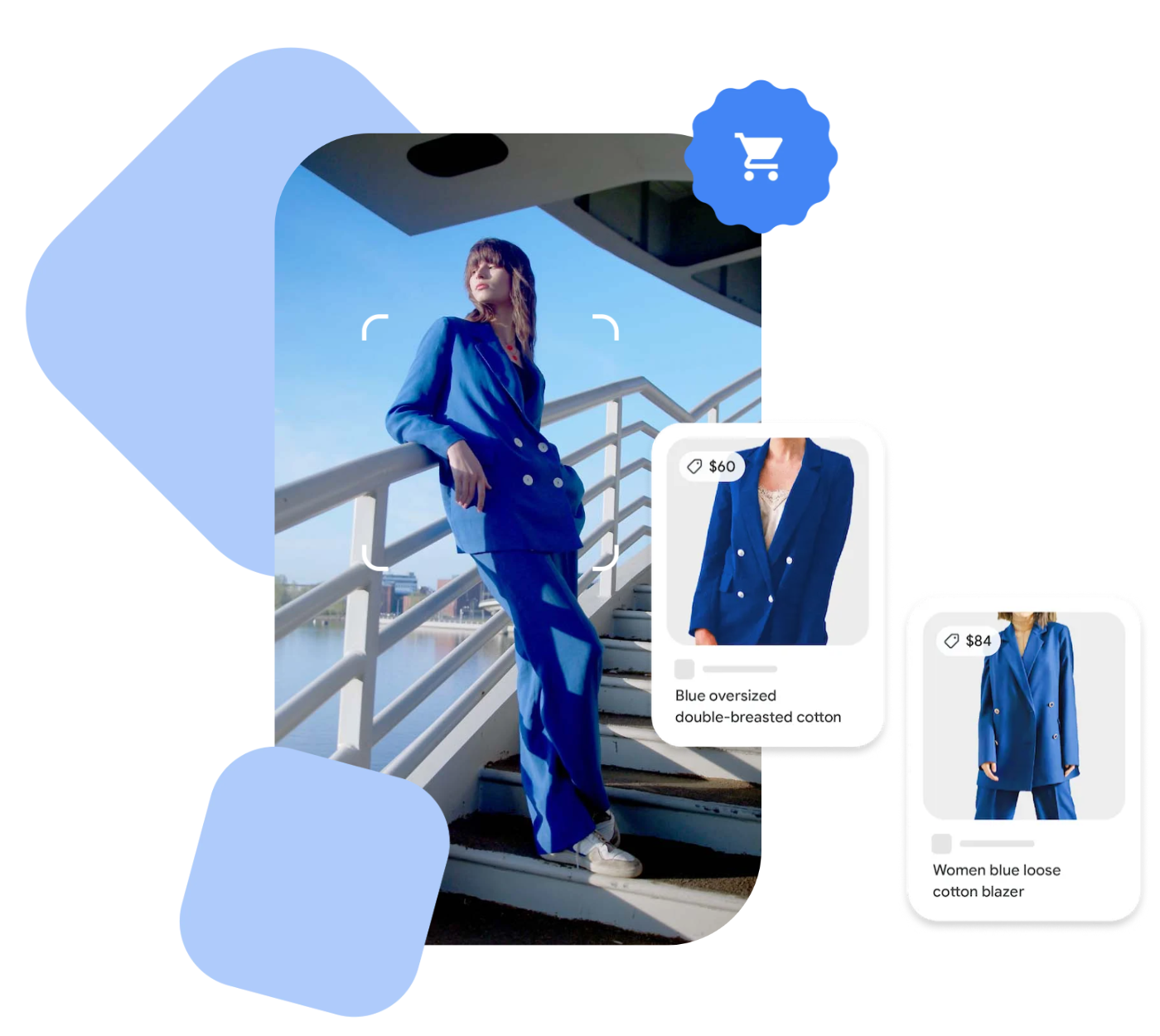
Image Source: Google
4. Augmented Reality (AR) Shopping Experiences
AR has been used for years as a way to enhance shopping experiences, growing alongside shopper preferences for omnichannel commerce, which blur the line between online and in-store shopping.
As AI technology has evolved, it has also been incorporated into existing AR technologies like virtual try-ons, in-room product placements, and interactive in-store displays.
Beauty brand L'Oréal Paris launched a new AI-powered tool Skin Genius, which uses AI-powered AR to make a personalized skincare routine from a skin analysis. The brand also offers makeup and hair color try-on tools, which help shoppers better visualize and color-match products virtually — a historically challenging part of selling beauty products online.
AI in Ecommerce for Brands: 3 Real-World Examples
As AI technologies continue to become more sophisticated, their benefits will also increase in lockstep. Here are some of the ways ecommerce organizations are currently using AI to automate processes and optimize operations.
1. Product Content Creation, Modeling, and Interpretation
For many brands, product content creation is the core area where they have focused their AI efforts. GenAI can help ecommerce teams scale the development of product descriptions, product images, and other essential product content at scale — allowing them to create high-quality content across product catalogs with less time than before.
In today’s world, AI systems need context; they need to understand the following about a product:
- Who it’s for;
- The problem it solves;
- When to recommend it;
- How it compares to other products; and
- The outcomes it supports.
Think about this as the shift from information to interpretation: Customers are now asking questions and expecting personalized, relevant answers.
Machine-readable structure matters, too, and AI tools can help ecommerce teams optimize data models, helping them avoid spending weeks structuring product data and ensuring a more accurate and efficient data model.
“A lot of companies for PIM [product information management] implementations will spend a lot of time thinking about data modeling,” Rob Gonzalez says. “Using GenAI can actually decrease the time to get to a model that is compelling for you.”
2. Product Data Quality Assurance
High-quality product data is essential for shoppers and helps brands meet retailer requirements, ensuring a streamlined go-to-market process. However, for large product assortments, quality assurance is time-consuming.
Gonzalez highlights how many retailer style guidelines have qualitative criteria. For example, retailer guidelines may request that brands avoid unverifiable claims in product descriptions.
“How do you check that if you have a huge product assortment?” Gonzalez says. “You can have an AI do that type of checking for you. ‘Find if this description has claims.’”
Ultimate Products, a premier consumer goods company, was facing significant operational hurdles when managing its massive product catalog of 6,500 parent SKUs and 20,000 variants spanning nine countries and seven languages.
Without a centralized system, data ownership and processes were entirely siloed across different teams. The company relied on more than 30 disconnected spreadsheets, unstructured shared drives, and endless email chains to manage its catalog.
More importantly, these manual, redundant processes were eating up valuable time, preventing the team from focusing on strategic, high-impact work.
“Simply put, our team was overwhelmed,” says Ben Gilmore, senior process developer at Ultimate Products. “Our processes were manual, and our systems were fragmented. It could take up to seven days just for us to transform images to meet a retailer’s requirements, and routing content updates took nine days to complete. We were spending hours reconciling conflicting information instead of focusing on growth and customers.”
With a robust foundation of nearly 700 custom workflows orchestrating everything from initial product creation to final channel readiness, Ultimate Products became an early adopter of Intelligence Suite, an AI-powered workbench designed to automate product experience management (PXM) processes while keeping humans in the loop.
After implementing, Ultimate Products achieved:
-
Massive time and cost savings: About 9,000 working hours per year, and nearly £200,000.
-
Commercial growth and increased conversion: An 11% year-over-year increase in Amazon conversion rates and an estimated £2.2 million increase in sales.
-
Accelerated speed to market: Turnaround times changed from seven days to near instantaneous, while others changed from two days to two minutes.
-
Scalable market expansion: An add of over 72,000 publishes across nine Amazon European marketplaces in just a year without increasing headcount.
3. Streamlined Workflows and Task Automation
Thinking outside of the product data box, AI-powered ecommerce tools can help increase efficiency and reduce manual effort for teams through automation of time-consuming tasks.
Using AI-powered automation, ecommerce teams can build scalable, repeatable processes using workflows — avoiding back-and-forth across teams — and can automate repetitive actions like updating properties, sending messaging, and publishing to configured channels.
UMA Home Décor leveraged AI tools to reduce content production time to weeks instead of months, building significant efficiencies in their go-to-market processes and allowing their team to focus on strategic initiatives to book sales.
“We’re so far ahead that we can actually go back to review and optimize old content,” says Rebekka Meters, director of creative and content at UMA Home Décor.
Intelligence Suite, proved to be “game-changer” for small appliance manufacturer Groupe SEB USA, leading to immediate and significant time savings, particularly with the company's alt text process.
“The alt text process is so important because we need to ensure we meet the ADA compliance regulations and provide a great shopping experience for all of our customers,” says Juliana Yepes, content operations lead. “But the creation and upload process for the alt text was very inefficient and frankly, very painful.”
Their entire alt text process, even for a large batch of 50–100 images, now takes about five minutes — down from more than two hours — with high-quality text generated in seconds.
“Intelligence Suite is an incredible innovation,” Yepes says. “It’s saved our team so much time and has totally evolved how we approach our product content operations. The only way to win in commerce today is to have the operational capacity to move fast and at scale. Intelligence Suite has helped us to do that.”
In fact, Salsify’s Intelligence Suite was recognized as “RetailTech AI Innovation of the Year,” because it helps brands eager for systems that reduce operational drag while improving quality at scale.
What Is the Future of Artificial Intelligence in Ecommerce?
“It’s going to be an amplifier — especially for those longtail products,” Gonzalez says. “And it’s going to make every single person on your team that’s responsible for the digital shelf more productive.”
Undoubtedly, as AI continues to evolve, so will its use in ecommerce.
These technologies will not only enhance shopping experiences — leading to better business outcomes for ecommerce — but will also help ecommerce teams reduce tedious, time-consuming tasks so they can focus on innovation to meet shoppers in the next era of shopping.

Mastering the Agentic Shelf: A PXM Playbook for AI in Ecommerce
Success in the new omnichannel era requires you to rank for the human shopper and satisfy the algorithm. Download this playbook for actionable insights on how to win at AI in ecommerce.
DOWNLOAD NOW.svg)
