


Product discovery used to happen in a small subset of established channels: search engines, retailer sites, marketplaces, brand websites. But these days, it’s no secret that there’s a new middleman in town complicating that picture: AI.
Search assistants and shopping agents now can, and do, influence which products consumers see, compare, and consider before they ever reach a traditional ecommerce search page.
All of which raises new, game-changing questions for brands: What does it mean to optimize product content when an AI system may be interpreting elements like shopper intent, comparing products, and deciding which ones are worth surfacing at all? Which parts of your product data matter most? And how do you stay visible when the path to purchase no longer runs through a single search box?
Those questions and more were at the center of the final installment of Salsify and DetailPage’s three-part AI path to purchase webinar series.
The session brought together Salsify’s Rob Gonzalez and DetailPage CEO Spencer Millerberg to examine the latest changes reshaping AI-powered product discovery and, more importantly, what brands can actually do about them.
The conversation focused on what AEO for ecommerce looks like as AI takes on a larger role in product discovery — and how brands can adapt their content, data, and ecommerce strategies accordingly.
AI Search Cares About Context — Not Just Keywords
For a long time, traditional ecommerce search strategy was focused on a relatively straightforward question: Does this product content match what the shopper typed?
But with LLMs increasingly capable of interpreting not just the query itself, but the context around it — who the shopper is, what they need, and where or how they plan to use a product — brands need to start providing those systems with a lot more information to work with.
“Now it’s not enough to pick the keywords,” Gonzalez says. “You have to pick all the other stuff, like the use cases.”
The same logic applies to product imagery. Millerberg says AI systems are using product images earlier in the discovery process, giving brands more reason to use clear lifestyle imagery, focused messaging, and text overlays that reinforce the product’s most relevant benefits.
The practical takeaway is: If an AI system has to decide whether your product fits a particular need or situation, your content needs to give it enough information to make that connection confidently.
Retailer Product Feeds Now Affect Visibility Beyond the Retailer
For brands, AI search isn’t just changing how product content gets interpreted. It’s also changing which sources AI systems rely on to discover that content in the first place.
Millerberg says DetailPage observed ChatGPT moving away from scraping retailer product detail pages directly and relying more heavily on structured retailer product feeds — the catalog data retailers receive and distribute about products.
That shift gives the information brands send to retailers a much larger role. Optimizing product content for Walmart, Target, Home Depot, and other retail partners may now influence not only how products perform within those sites, but how they surface in AI-generated recommendations elsewhere. Millerberg also encouraged brands to think outside the PDP, noting that brand websites, reviews, Reddit, and other publicly available information all contribute, but often play different roles.
Example: What Makes Eye Cream Results Run Smoothly (or Not)
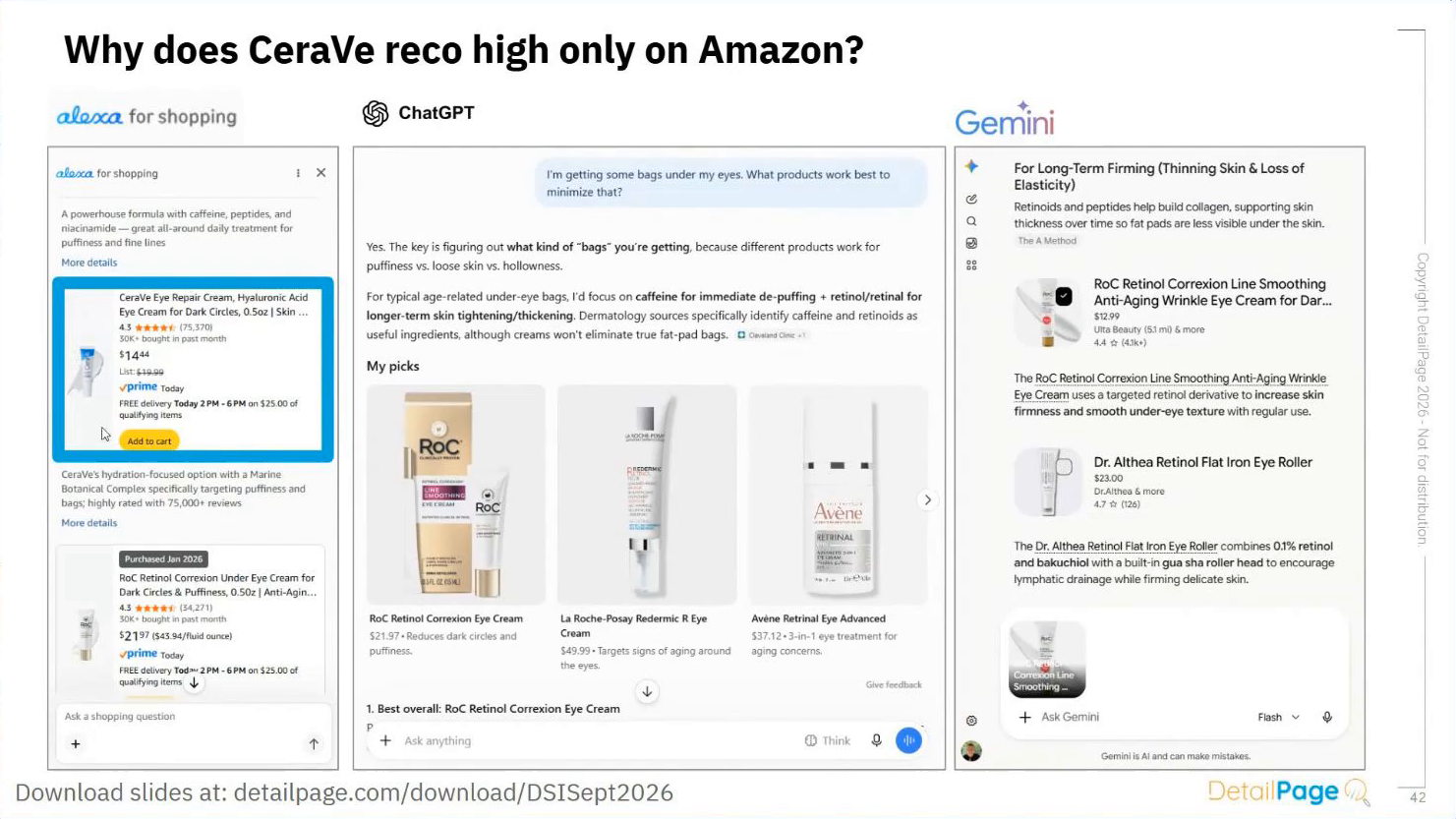
Millerberg pointed to CeraVe’s line of eye cream as an example: When one shopper searched for products to address bags under their eyes, CeraVe appeared in Alexa’s shopping recommendations, while ChatGPT and Gemini surfaced competing products.
The reason? Millerberg notes that CeraVe’s Amazon listing clearly addressed dark circles and puffiness, while its Walmart and Target content was less explicit — leading to a visibility gap on the AI platforms drawing from other retailer feeds.
Takeaway: How To Combat Visibility Gaps
Because of these visibility gaps, product syndication is more than a catalog-management exercise. Brands also need to make sure optimized content stays live after publication, making ongoing monitoring part of the job. In practice, syndication becomes an active part of the GEO strategy — not a one-time handoff once content is published.
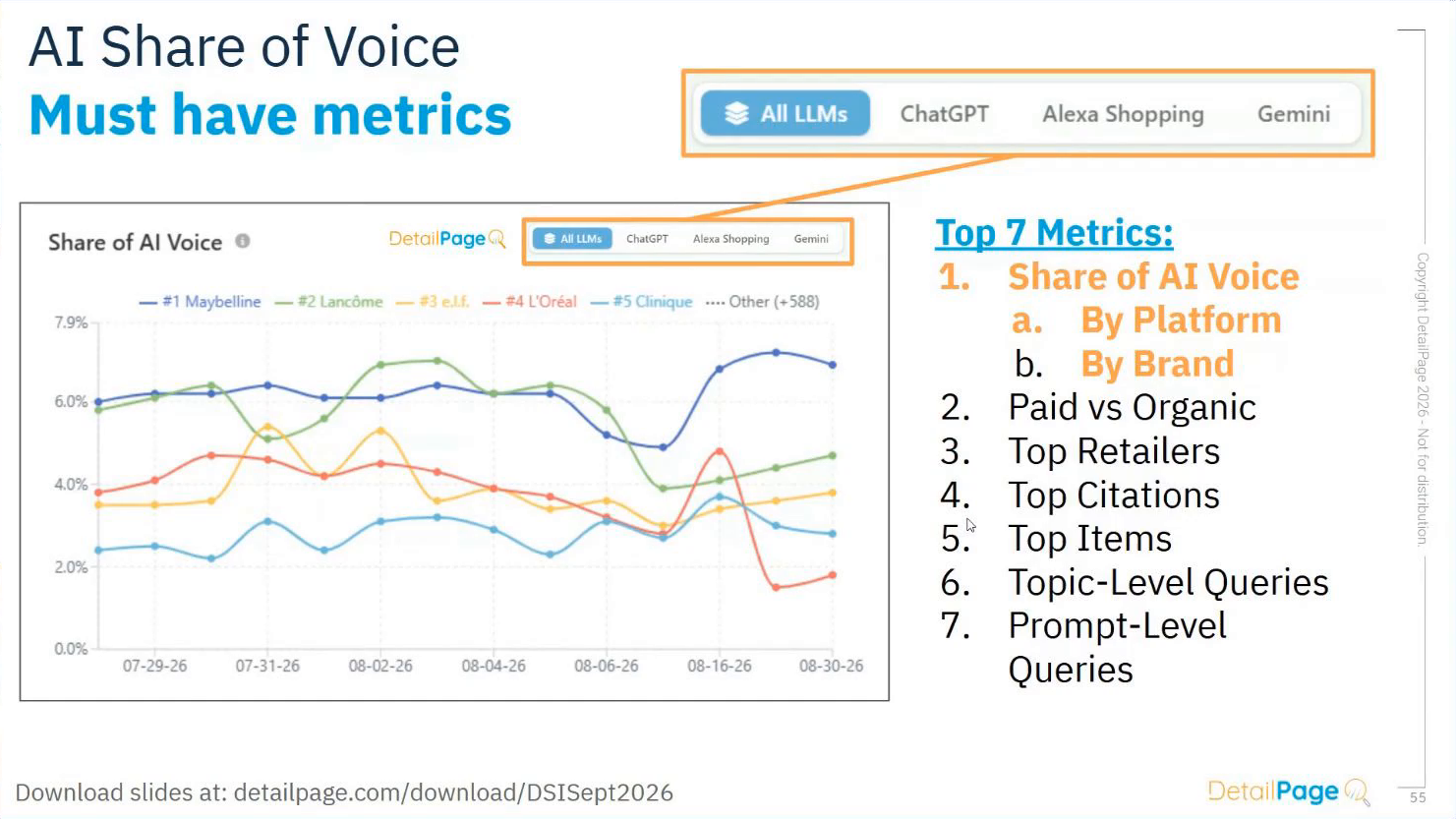
Millerberg recommends tracking AI share of voice — i.e., how often a brand surfaces relative to competitors — across related shopper questions, rather than judging performance on the basis of a single keyword alone.
AI Adoption Requires New Content Workflows
For all the attention paid to what ecommerce AI can automate, adopting it can also create a surprising amount of new work for ecommerce teams.
“Nothing is standardized, and everything’s changing all the time,” Gonzalez says. “It’s just like a net additional amount of work.”
Part of the problem is that the ecosystem is still fragmented. A product image optimized for one retailer may need to be reformatted or recreated for another, while the rules governing how AI-generated or AI-enhanced content can be used continue to vary by platform and market.
Example: Meet Disclosure Requirements in Your Market
Millerberg pointed to AI disclosure requirements as a key example. In the U.S., New York requires disclosures in advertising that uses synthetic performers — digitally created people used in lieu of actual, human performers. In the EU, the AI Act sets even broader transparency requirements, including disclosure when content meets a legally defined threshold for “deepfake.”
As a result, teams will need to find a way to flag images that require disclosure under the rules of the market in which they’ll appear.

Example: Meet Disclosure Requirements for Your Retailers
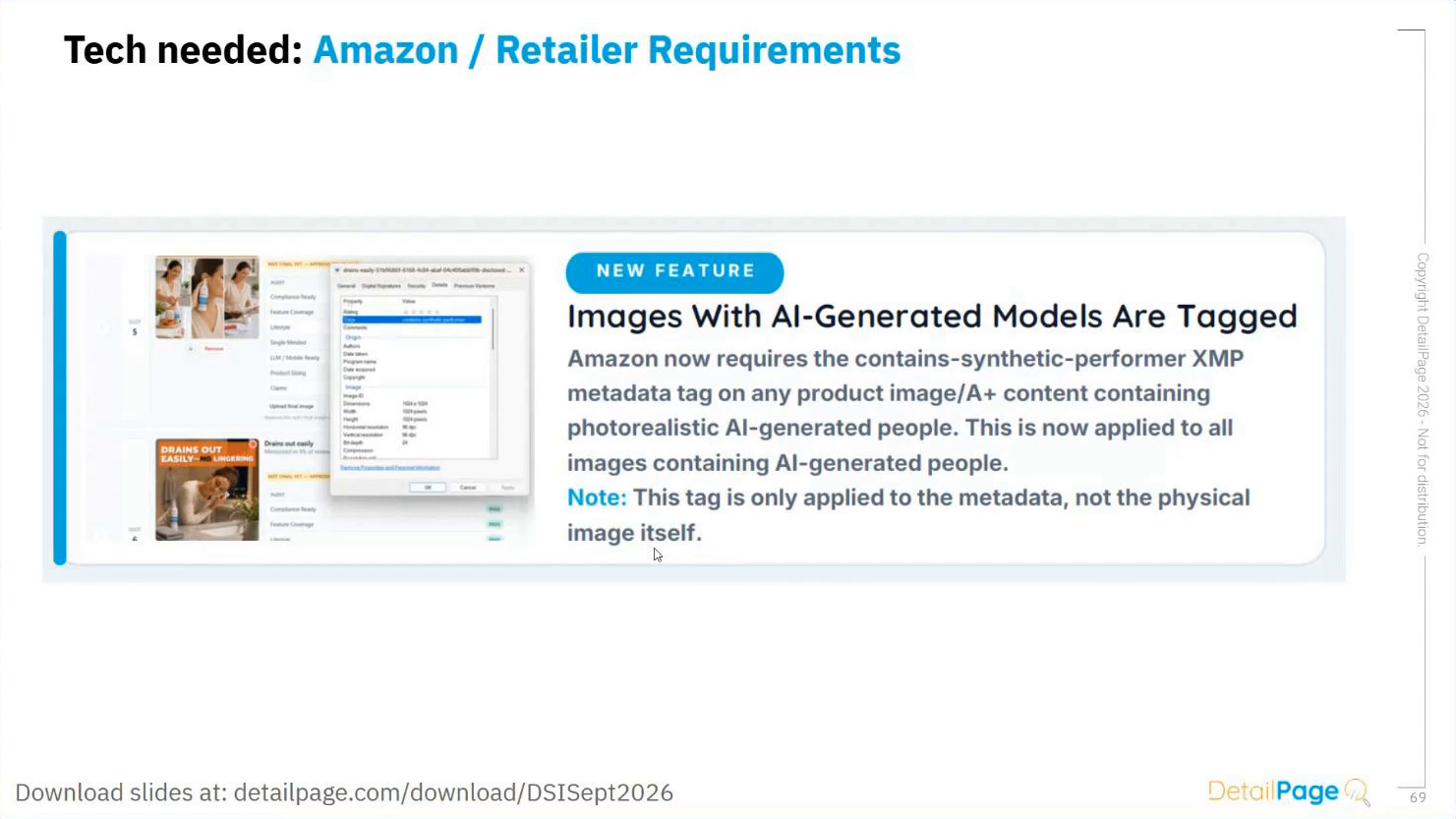
Retailer requirements add another dimension. Amazon requires images containing photorealistic AI-generated people to carry a “contains-synthetic-performer” tag in their XMP metadata — information embedded in the file — before upload to listings or A+ content. That means that, beyond creating the image, teams will now need to identify which assets require tagging and make sure that information reaches the retailer.
On top of that, Millerberg says the effects of content optimization often emerge gradually, with direct retail performance taking several weeks to settle into a new baseline and visibility changes in platforms like ChatGPT and Gemini taking longer still.
Takeaway: Rethink How You Measure and Achieve Results
AI adoption is a workflow question as much as a technology question. Global brands may need to rethink how teams create retailer-specific content, who is responsible for reviewing and maintaining it, and how long they give tests to run before deciding whether a change works in the long run.
Optimize for an AI-Driven Path to Purchase
AI is changing more than where shoppers search. It’s changing what brands need their product content to do once machines become part of the discovery process.
For brands investing in AEO for ecommerce, that means treating product information as something that has to remain useful well beyond the PDP. It needs enough context for AI systems to understand it, while the teams behind it need workflows that can keep that information accurate as platforms, feeds, and requirements continue to change.
AEO and GEO are still evolving, but the direction is becoming clearer: Product visibility increasingly depends on how well brand data can travel through an AI-driven commerce ecosystem.

AI Path to Purchase: The Next 5 Years Starts Now
Could your brand be losing visibility as AI reshapes how products get discovered? Explore the full AI path to purchase webinar series for a closer look at how to stay ahead.
EXPLORE NOW
