

Not that long ago, back-to-school shopping meant one trip to Payless and a fresh pack of pencils. You could do it in an afternoon.
According to PwC's 2026 back-to-school survey, students are now discovering products on social platforms, following trends, and curating wish lists that go straight into a digital cart — sometimes with a parent's input, sometimes without.
The list has been replaced by a shared, ongoing, increasingly digital negotiation between parent and kid.
Salsify's “2026 Consumer Research” report found that shoppers, broadly, are pulling back on spending this year. Parents are the exception. They're planning to spend more, and two forces are pulling them in that direction: The first is sitting at their kitchen table, adding things to the cart; the second is whirring away in the background, helping them decide what's worth buying.
Learn more about why parents are bucking the spending pullback, who (and what) is shaping Gen Alpha's preferences, how much sway those preferences actually have on the household budget, and how AI is stepping in to help parents shop smarter under pressure.
Why Parents Are Planning To Spend More This Year
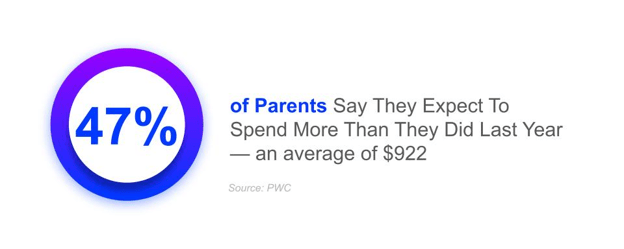
Parents aren't just absorbing the rising costs this season; they're actually budgeting for them. According to PwC, parents expect to spend an average of $922 getting their kids ready for the year, and 47% say they'll spend more than they did last year, a sharp jump from the 35% who said the same in 2025.
There’s a pattern with where that money’s going. Clothing and shoes are eating the biggest share of the budget, with three out of four families spending at least $100 here, averaging $278 per household, more than double the $122 households spend on core school supplies like backpacks, binders, and pencils.
Technology isn't far behind, averaging $222 per household, as more schools lean on devices as a baseline requirement.
Some of that increase comes down to the basics: Kids move up a grade, outgrow clothes, and need new gear. But it’s also pressure that didn't used to exist or certainly wasn’t as loud as it is now.
Nearly a third of parents (32%) say their kids are specifically requesting name-brand or trend-driven items, and 26% say they need to upgrade their kids' tech. Add in the fact that 71% of families cram all of this shopping into a window of just two weeks to two months before the first bell.
This chaotic window creates a short, high-pressure season where brands and retailers have to get the messaging, inventory, and product content right immediately.
Who (and What) Is Influencing Gen Alpha
Gen Alpha (kids born between 2010 and 2024) is already the largest generation in history, made up of more than 2 billion people around the world. Most of them can't legally hold a job, let alone a credit card, but that hasn't stopped them from becoming one of the most influential forces on the household budget.
Source: TikTok Shop
So where are they getting their ideas? Not from a store aisle, that’s for sure. PwC's research paints a picture of a generation that discovers products the same way they discover everything else: through social platforms, peer trends, and carefully built wish lists.
“Wish list" undersells it, really. PwC notes that today's version is often a curated slideshow or aesthetic mood board, built using the same tools their parents use for work presentations.
Peer influence plays a role too, but increasingly, it's internet personalities and influencers doing the heavy lifting. For tweens especially, influencer recommendations now rival in-store browsing as a way to discover new products, meaning a brand's shelf presence matters a lot less than its presence in the feed.
Gen Alpha's Influence on Back-to-School Spending
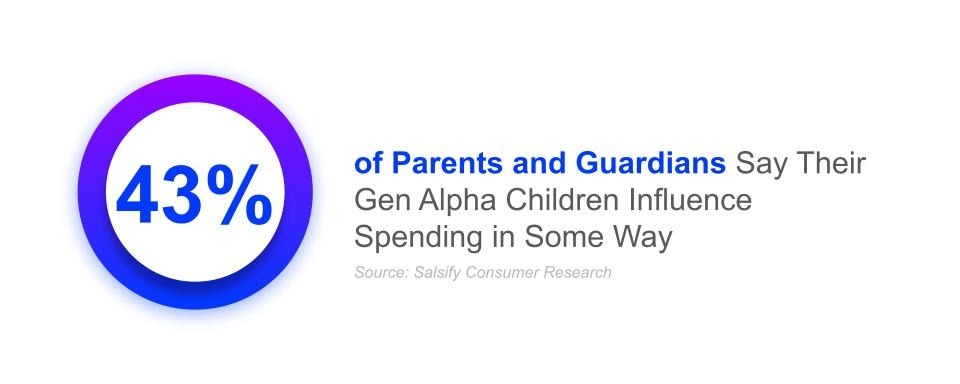
The discovery habits are one thing, but the real question is whether that influence translates to the cart. In short, it does. Salsify's research found that 43% of parents and guardians say their Gen Alpha kids influence spending in some way, and 9% say their kids influence most household purchases outright.
Back-to-school season makes that influence particularly noticeable, because kids are the ones doing the shopping. PwC found that 61% of parents let their kids participate directly in online shopping.
Some of this happens through a child's own account (40%), and some through a shared or linked family account (31%). Either way, the days of a parent acting as the sole gatekeeper between a kid's wish list and the checkout button are fading fast.
That influence isn't evenly spread across categories, though. Gen Alpha's sway is strongest in food and beverage, fashion and apparel, and electronics, where influence rates land in the 19–26% range.
Age changes the equation too. Because when it comes to generational spending, what's exactly driving purchase decisions in 2026?
Tech purchases are a clear example: half of high school parents say their child influences tech buying decisions, compared to less than a quarter of middle school parents. As kids get older and more independent, their opinions carry more weight, and their parents' willingness to defer to them grows right along with it.
All of this points to the same conclusion: Parents aren't a monolith, and Gen Alpha parents are shopping under a different set of pressures than most.
How AI Is Helping Parents Save (and Decide)
If Gen Alpha is one force pulling parents to spend more, AI is the other. PwC found that 73% of families will use AI somewhere in their back-to-school process this year, whether that's researching brands, comparing products, budgeting, or hunting down deals. For context, this is a channel that barely registered a year ago.
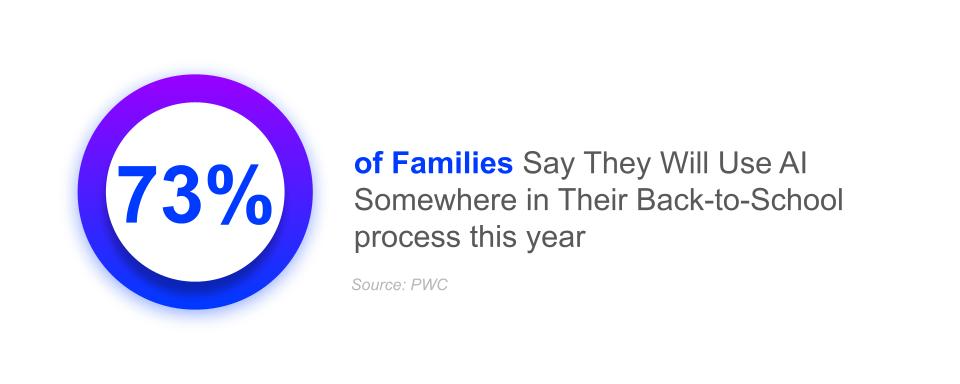
The clearest example of that shift: 23% of parents are specifically using AI to find deals, a category PwC describes as one that "didn't meaningfully exist" in last year's back-to-school season.
It's worth explaining what "using AI" actually means here.
Salsify's “2026 Consumer Research” report shows a much more cautious relationship with AI for shopping overall:
- Only 14% of shoppers trust AI recommendations alone to make a purchase decision.
- Another 27% will use AI but verify what it tells them elsewhere, via a review, a second site, or a friend.
- And a full third (33%) don't use AI shopping tools at all.
Put simply, parents are treating AI as a research assistant, not a personal shopper.
That caution makes sense once you look at how fragmented the actual path to purchase has become. In-store shopping is still happening, but it's slipping. It’s down to 70% of parents, from 79% just a year ago.
The share hasn't disappeared completely, though:
- 67% of parents will shop at major online marketplaces;
- 49% will go directly to brand or retailer sites; and
- 23% are heading to social platforms or using AI-powered discovery.
Notice how there’s no single channel that comes out on top. Instead, parents are stitching together a purchase journey from all of them at once.
3 Action Items for Brands and Retailers
Parents have a lot going on at all times. How can brands and retailers capture the back-to-school parent in their chaotic day?
1. Show Up Everywhere at Once
The path to purchase isn't linear anymore, and it isn't shrinking to one or two dominant channels either. A product can get discovered in a TikTok video, price-checked by an AI tool, and ultimately bought on a marketplace, all within the same week, sometimes the same afternoon.
2. Build Content That Answers to 2 Audiences
Every back-to-school purchase now has two decision-makers with two different priorities: the parent weighing price, durability, and whether this purchase is actually necessary, and the kid who cares whether it's trending, on-brand, and worth showing off.
Tackle this by pairing practical specs with the visual, social-proof-driven content that gets a kid's attention.
3. Get Product Data AI-Ready
Nearly a quarter of parents are already using AI to hunt deals, and most others are using it to research and compare somewhere in the journey. Make sure your product data is accurate, complete, and consistent everywhere.
Don't Abandon the Fundamentals
None of this means chasing AI at the expense of everything else. Trust in AI-only recommendations remains low, and most parents verify elsewhere before they buy.
That means strong product detail pages (PDPs), credible reviews, and a solid in-store experience are still doing most of the work of actually closing the sale.
Back-to-school is a preview of where shopping is headed more broadly: collaborative, AI-assisted, and shaped by more voices than just the person holding the credit card.
.svg)
