


Agentic commerce isn’t a futuristic concept floating around innovation decks and keynotes anymore.
It’s here. AI agents are already very capable of discovering products, comparing options, evaluating reviews, and even completing purchases on a shopper’s behalf. The technology is evolving fast, and in many cases, it’s technically ready to take on far more of the buying journey than consumers realize.
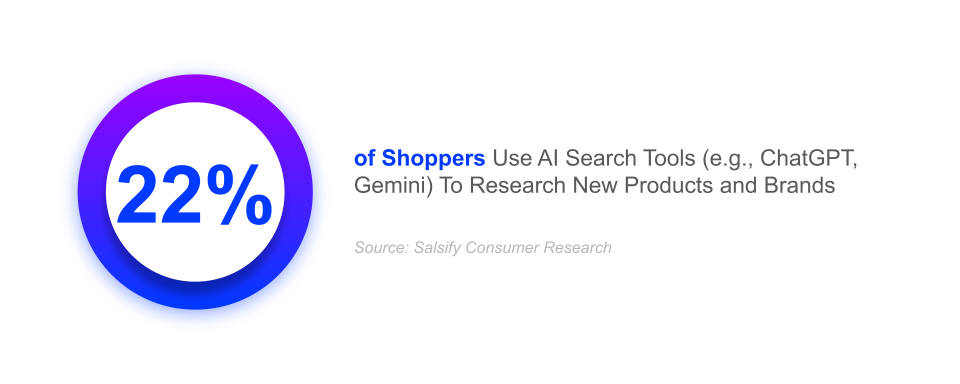
But just because AI agents can shop for us doesn’t mean shoppers are ready to hand over the reins. Salsify’s “2026 Consumer Research” report shows that while 22% of shoppers are already using AI tools to research products, only 14% say they fully trust those recommendations enough to make a purchase.
Even more telling is that a full 33% don’t use AI shopping tools at all. This is the reality brands need to grapple with. Yes, adoption is happening, but cautiously, which begs the question: How do you build shopper trust in something that is still very new?
The AI Trust Gap: The Biggest Barrier to Agentic Commerce
If there’s one thing standing between today’s AI capabilities and the widespread adoption of agentic commerce, it’s trust.
According to Salsify’s latest consumer research:
- 22% of consumers are already using AI tools to shop or research products.
- 14% say they trust those tools enough to use them regularly without hesitation.
- 27% trust them but verify recommendations elsewhere before buying.
- 6% don’t trust them at all.
That’s the AI trust gap in action. Shoppers are curious. They’re willing to explore. But they’re not ready to surrender control.
Today’s behavior looks like this: Use AI for discovery, cross-check on marketplaces, scan reviews, compare prices, maybe check social media, and then decide. AI is part of the journey, but it’s not the final authority.
And that’s completely rational. Shopping isn’t just transactional; it’s emotional and financial. When money is on the line, especially for higher-ticket purchases, people want reassurance.
For brands, just winning the AI recommendation isn’t enough.
Complete Product Content Equates To AI Trust
If an AI agent surfaces your product but your product detail page (PDP) content is incomplete, if reviews contradict your claims, or if specifications differ across retailers, you instantly lose trust.
Agentic commerce magnifies every single inconsistency, however small. AI agents rely on structured, accurate, and consistent data when autonomously comparing options.
If your product information differs across channels, the agent might push it down the rankings — or, worse, recommend it based on incomplete or inconsistent information.
That’s when shoppers end up with something that doesn’t match their expectations, which can mean more returns, frustration, and a dent in their trust.
Generational and Gender Differences in Agentic Commerce Adoption
Not all shoppers are approaching agentic commerce the same way, and that’s actually a good thing. It means brands don’t have to win everyone over at once. You can be smart about where you focus first.
There are two things Salsify’s consumer research report revealed.
1. Millennials Are Leading Adoption
Thirty percent of millennials say they’re interested in using AI shopping agents. Gen Z isn’t far behind at 26%, followed by Gen X at 21%. For baby boomers, it’s just 5%.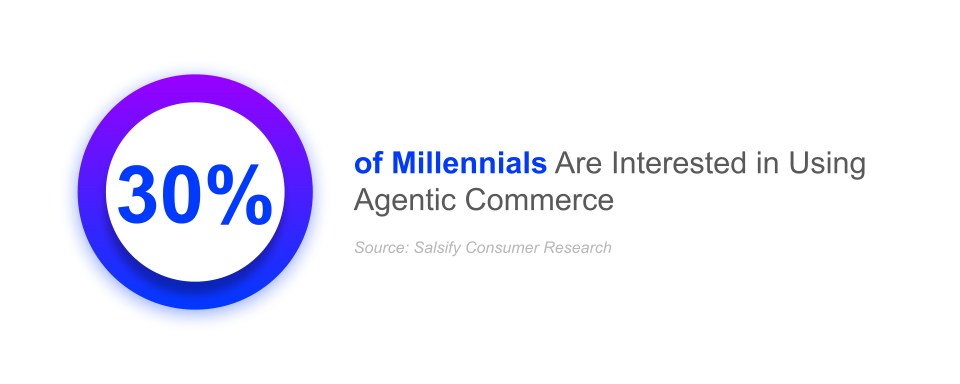
When you look at trust levels, the story becomes even clearer. More than 20% of millennials say they trust and use AI shopping tools regularly, while 55% of baby boomers don’t use them at all.
This makes perfect sense when you zoom out. Millennials grew up alongside the rise of ecommerce. They were early adopters of online banking, ride-sharing, mobile payments, and subscription services.
Delegating decisions to technology doesn’t feel foreign to millennials and Gen Z in the same way it does for older generations.
2. Men Are More Likely To Use AI To Help Purchase
There’s also a noticeable gender difference in early AI-driven purchasing behavior.
Twenty-six percent of men say they’ve purchased a product because an AI tool recommended it, compared to 17% of women.
Again, this doesn’t mean women are less tech-savvy. It suggests differences in risk tolerance and decision style. Research consistently shows women tend to seek more validation before purchasing, especially in categories tied to personal care, family, or higher emotional investment.
Men, on average, are slightly more likely to experiment with emerging tools and act on recommendations sooner.
Put it together, and the early adopters of agentic commerce skew:
- Younger
- Male
- Digitally comfortable
For brands, this is incredibly useful information. You don’t need a sweeping, one-size-fits-all rollout. You can pilot agentic strategies with these segments first and expand from there.
What Makes Shoppers Trust AI Agents Enough To Buy
If you want agentic commerce to work commercially as well as technically, you have to understand what actually makes shoppers feel comfortable clicking “buy” when AI is involved.
According to Salsify’s consumer research report, shoppers say they’re most likely to trust an AI recommendation when they see:
- Detailed product descriptions and specifications (31%)
- Brand recognition (27%)
- Personalized explanations for why the product fits their needs (25%)
- Customer reviews and ratings (25%)
- Product comparisons with similar options (21%)
It’s the same things that have always driven ecommerce trust: Clear specs, strong branding, helpful context, social proof, and easy comparison.
The big insight here is that AI trust is built on traditional ecommerce fundamentals.
Shoppers still want reassurance when an AI agent recommends a product. They want to know the details are accurate. They want to recognize the brand. They want to understand why this product fits their needs. And they absolutely want to see what other people think.
Basically, agentic commerce intensifies the strategy you already have in place. If anything, the bar gets higher.
AI agents rely on structured, comprehensive data to evaluate products. Shoppers rely on that same content to validate the AI’s recommendation. If your descriptions are thin, your specs are incomplete, or your reviews are sparse, trust will break down very quickly.
Why Inconsistent Product Content Will Break Agentic Commerce
According to Salsify’s consumer research, today’s shoppers abandon carts for very human reasons:
- 42% walk away because there are no (or low) customer ratings.
- 38% leave when product information is inconsistent across websites.
- 34% abandon because descriptions are poorly written.
It doesn’t stop at checkout either. Forty-five percent of shoppers have returned a product because the content was inaccurate. Among millennials, that number jumps to 56%.
If inconsistent content frustrates humans enough to abandon or return, imagine how it looks to an AI agent.
AI doesn’t “give the benefit of the doubt.” It scans, compares, and ranks based on structured signals. If your specs don’t match across retailers, if attributes are missing, or if reviews contradict claims, it might simply drop you from its rankings.
What It Takes To Build Shopper Trust in Agentic Commerce
Trust can’t be an afterthought if agentic commerce is going to work at scale. It has to be built deliberately. Here are the five pillars you can use to do that.
1. Radical Product Content Consistency
You need one source of truth for your product data.
From there, that content needs to be syndicated consistently across every channel: marketplaces, retail sites, direct-to-consumer (D2C), social shops, and whatever AI-powered surfaces emerge next.
It can’t just look good to humans, either. It has to be structured so AI systems can easily ingest (and digest it), which means accurate attributes, standardized specs, complete fields, and all that good stuff.
2. Detailed, Context-Rich PDPs
AI agents rely on context to evaluate products, and so do shoppers. The more complete your page, the more confident both parties will feel.
That means:
- Clear, comprehensive specs
- Side-by-side comparisons
- Real-world use cases
- FAQs that answer actual objections
- Strong visuals from multiple angles
- Video where it adds clarity
3. Brand Visibility Across the Ecosystem
Twenty-seven percent of shoppers say they trust AI recommendations more when they recognize the brand. That’s huge.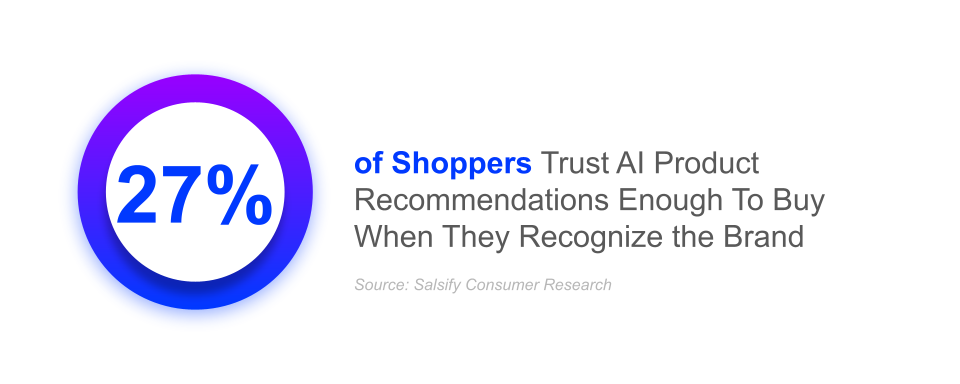
Trust increases almost instantly if an AI agent recommends a product from a brand the shopper has seen before (e.g., on a marketplace, in reviews, on social, in-store). Visibility is so much more than a marketing play here.
That means you need:
- A strong marketplace presence;
- Consistent review generation;
- Social proof across channels; and
- Paid and organic visibility working together.
4. Transparent Personalization
Personalization is powerful, but only when it feels earned. Salsify’s consumer research found that 25% of shoppers say they trust AI recommendations more when the explanation is personalized to their needs.
To support this, brands need to:
- Provide structured attributes that AI can match to preferences;
- Enable strong filtering logic (size, material, lifestyle fit, etc.); and
- Support persona-based PDP variations where possible.
5. Controlled Autonomy (Not Full Automation)
Shoppers aren’t all-in on full autonomy yet. The interest in agentic commerce is still very mixed, with 35% of shoppers citing trust concerns and 31% saying they don’t like giving up control of their shopping decisions.
That’s very telling.
The future likely won’t be “AI does everything, humans disappear.” It will be more nuanced.
Think:
- Assisted autonomy
- Approval checkpoints before checkout
- Adjustable agent parameters (“Only buy from brands I trust,” “Stay under $100,” etc.)
Trust will grow gradually rather than overnight.
The Omnichannel Reality: AI Doesn’t Replace Human Behavior (Yet)
For all the excitement around AI, shoppers haven’t suddenly abandoned their usual habits.
Discovery still happens the old-fashioned way: in physical retail stores (60%), on online marketplaces (57%), and through social media (52%).
AI may be growing, but it hasn’t replaced browsing the aisle, scrolling TikTok, or checking Amazon. And when it comes to research, shoppers are anything but one-track-minded.
Fifty-four percent use two to three channels before buying mid-range items, and 30% review four to six channels for big-ticket purchases.
What does this mean for agentic commerce?
It means that it’s not going to wipe out omnichannel shopping. It’s going to sit on top of it.
AI will become another layer in the journey, rather than the only one. So brands can’t treat it as a standalone strategy. Your digital shelf, physical shelf, marketplace listings, retail content, and AI-facing data all need to tell the same story.
Agentic Commerce Will Be Won by Trust, Not Algorithms
Yes, agentic commerce is exciting, and the technology is advancing quickly. But the AI gap is real, and it’s not closing overnight.
Millennials and younger shoppers are helping move things forward. They’re more open, more curious, more willing to experiment than older generations, but even they aren’t blindly handing over control.
At the heart of all of this is something much less flashy than AI: product content and consistent information everywhere a shopper (or an AI agent) looks.

2026 Consumer Research Report
Agentic commerce is just one piece of a much bigger shift in how people discover, evaluate, and buy products. If you want the full picture, download the “2026 Consumer Research” report.
DOWNLOAD NOW.svg)
