

We’ve officially entered the AI-powered shopping era.
Consumers are using AI across the shopper journey: 64% of shoppers use AI shopping tools to discover and research new products, according to Salsify’s “2026 Holiday Pulse Report."
Shoppers are increasingly turning to AI, according to other industry research. Globally, 58% of consumers now use AI tools such as ChatGPT in place of search engines to find product or service recommendations. About seven in 10 consumers even want generative AI incorporated into the shopping experience, according to a Capgemini report.
Generative AI tools have grown in popularity over the last four years, notes Dataversity, but the next evolution of AI is taking hold on the digital shelf: agentic commerce.
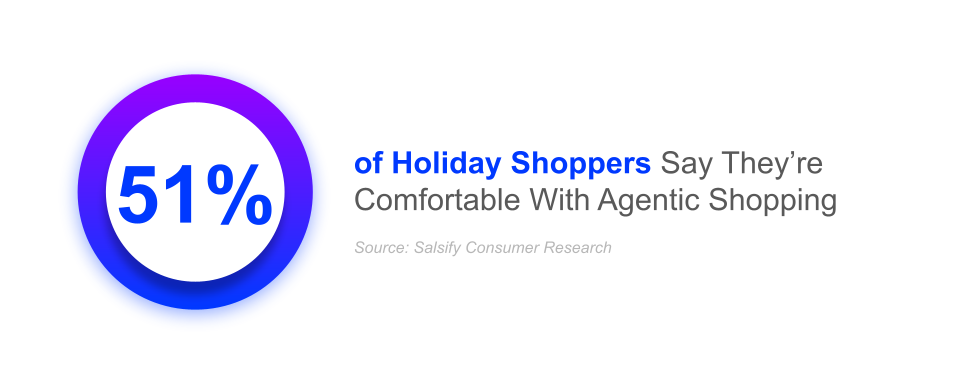
As brands gear up for the holiday shopping season, it could present a prime opportunity for them to deliver agentic shopping experiences — especially since 51% of shoppers say they’re already comfortable with agentic shopping and 54% say AI tools like chatbots and gift guides can improve holiday shopping.
So, what exactly is agentic shopping, and how can brands better prepare for it?
An Arsenal of Expert Insights on AI and Shopping
Here are insights from the Digital Shelf Institute’s (DSI) executive community that explain everything from the differences between generative AI vs. agentic AI to the most relevant agentic AI and ecommerce examples today.
This blog includes unique perspectives from:
-
Natalija Pavic, senior director, product marketing at KIBO Commerce, discusses what agentic shopping actually looks like and why answer engine optimization (AEO) is so critical for brands.
-
Rob Gonzalez, co-founder and chief innovation officer, Salsify, shares why agentic commerce won’t take over every commerce channel and how brands can increase their data readiness for the agentic AI era.
-
Marilia Moreira, digital marketing director at Whirlpool Corporation, explains why AI discoverability needs to become a strong internal capability for companies.
-
Russ Dieringer, founder and CEO of Stratably, shares why brands shouldn’t surrender to the agentic hype.
-
Collin Colburn, VP, commerce and retail media at IAB, explains why companies must address the AI trust gap.
Natalija Pavic, Senior Director Product Marketing at KIBO Commerce: What Agentic Shopping Actually Looks Like
Agentic AI uses autonomous agents to independently handle specific workflows and processes.
In commerce, companies can use agents to power commerce experiences and support digital shelf operations, including deploying AI shopping assistants that help consumers select and buy products or using a merchandising agent internally to generate product descriptions.
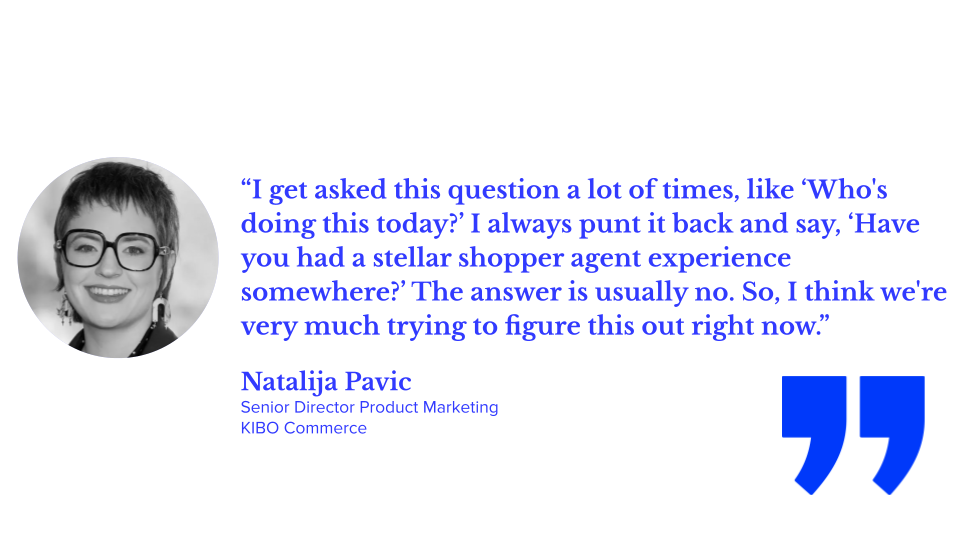
“An agent is an autonomous process that is virtual and executes on behalf of your company or on behalf of your customers,” Pavic says. “And AI means that it has an AI layer. They are generative in nature — generative from the perspective of understanding intent and understanding what customers and employees are requesting. But they’re agentic from the perspective of being able to execute within a system what they're [a user] is asking for.”
Pavic adds that shopper agents are what most people identify as agentic commerce today, but she hasn’t seen this use case done well yet.
Mastering AEO, or Answer Engine Optimization, Will be Critical
While brands figure out where to go next, shoppers are already integrating AI into the buying process. If six in 10 shoppers use AI to discover and research products, brands now have to optimize for AI discoverability.
You’ve probably seen tons of LinkedIn posts about the rise of AEO (also called answer, AI, or answer engine optimization). Pavic says the emergence of agentic commerce will make AEO even more important.
“SEO is dropping for a lot of companies, and consumers are leveraging GPTs for discovery,” Pavic says. “So you really have to start thinking about AEO, or agent engine optimization, as opposed to SEO. That may potentially overtake SEO as the dominant way in which shoppers consume information on your site.”
Going forward, brands and retailers shouldn’t look only at competitors in their category as a threat to their market share, Pavic says. They need to view GenAI engines as competitors, too.
“The other sort of tip of the spear here is, why are customers going to Gemini, ChatGPT, and Perplexity?” Pavic asks. “People are saying, ‘Well, nobody has a good shopper agent, and why should we invest in one?’ But you're not competing against other retailers, you're competing against the generative providers who are already owning that customer relationship.”
Marilia Moreira, Digital Marketing Director at Whirlpool Corporation: Make AI Discoverability A Foundational Digital Shelf Capability
Some brands, like Whirlpool, are already taking proactive steps to increase AI discoverability.
“When I say … SEO, AEO, GEO, [we’re looking at] all those acronyms with the same intent, and that is increasing visibility, increasing how many times we're cited and recommended by the agents,” says Marilia Moreira, digital marketing director at Whirlpool Corporation. “It has been a very rewarding experience to see how we're trending in this space right now in terms of AI overviews and so on.”
Moreira’s team is already optimizing the product detail page (PDP), understanding that it will greatly influence AI search and Whirlpool’s future agentic shopping experiences.
![“We started to put a lot of effort into the PDP itself and the product education because [we realized] it's not about ranking number one on how to best clean dishes. It is about ranking number one in the top three that agent will recommend.” — Marilia Moreira, Digital Marketing Director, Whirlpool Corporation; agentic shopping, AI shopping, and illustrating agentic AI and ecommerce examples and generative AI vs agentic AI](https://www.salsify.com/hs-fs/hubfs/marilia%20moreira%20agentic%20commerce%20blog.png?width=960&height=540&name=marilia%20moreira%20agentic%20commerce%20blog.png)
Rob Gonzalez, Co-Founder and Chief Innovation Officer, Salsify: Agentic Is One Channel — Not the Only Channel
Although AI-powered shopping is growing, agentic commerce won’t dominate every other ecommerce channel, Gonzalez argues.
“There seems to be this belief amongst AI maximalists that agentic commerce will somehow take over all other forms of commerce,” Gonzalez told Tech Bullion in a recent interview. “This is nonsense. It’ll just be another way to shop. Sometimes it will make sense, sometimes it won’t."
For example, consumers prefer to shop for groceries in-store, while they often turn to subscriptions or Amazon and other online marketplace platforms for household essentials, Gonzalez says. However, GenAI engines like Gemini and ChatGPT may be their first stop when buying electronics.
AI ultimately will help consumers answer questions about product compatibility, find items for specific projects, such as a cross-country move, and drive a personalized product discovery and buying experience.
“There’s a whole class of personalization,” he says. “‘That shirt looks good on that model, but he’s 6'0 and I’m much shorter, will it work on me?’ Or, ‘I liked this book and that book, but NOT this other book that most people recommend. What should I read based on that nuance?’”
Data Is the Foundation of an Agentic-Ready Commerce Operation
Gonzalez says accurate and contextually relevant product data is vital for delivering agentic shopping experiences.
“What’s key is visibility on the agentic shelf; when a shopper is using AI for discovery (I’m skeptical it will be used for transactions at any volume anytime soon) — how do you make sure your products are visible?” he shared. “OpenAI’s product data feed gives us strong hints as to what information matters, and it’s the contextual data: when is the product used, what it is used with, what is it used for, what is it used instead of, etc. That will help impact it.”
Brands also need to focus on the PDP because that will shape what consumers learn about their products via AI.
“AI agents scrape existing product detail pages for data, so by getting those right, you help win with agentic commerce, too,” Gonzalez shared.
Russ Dieringer, Founder and CEO of Stratably: Agentic Hype Shouldn’t Undermine Core Ecommerce
Dieringer says it’s important for brands to be forward-looking, but not at the expense of the near-term need to deliver better ecommerce experiences. The latter has always been a work in progress, and brands still have to make ecommerce a priority.
“I'm not sure there's ever been a time where there's been as much FOMO on stuff as there is right now, mostly because of agentic commerce,” Dieringer says. “For the last 18 months or so, it has just been a wild world of announcements and investments on behalf of the tech companies, evolving business models, and frankly, I think a lot of hand-wringing inside of our consumer brand clients.”
“Every C-suite is so hyper-focused and interested in agentic commerce and then only mildly interested in ecommerce,” he adds.
Stratably, a research and analyst firm that provides ecommerce insights for the industry, did a tally at a recent digital conference and found:
Only three out of 31 companies in attendance even mentioned agentic.
Only L’Oreal referenced specific tactics, saying it was loading its structured data into ChatGPT to help it gather and analyze insights.
The key takeaway here is that while many brands are embracing AI more broadly, they aren’t yet fully operationalizing agentic commerce.
Dieringer thinks agentic doesn’t currently offer a first-mover advantage for companies. However, they should still begin experimenting with it.
![“It's unclear if you're a first mover today into agentic that you're going to have some long-term competitive advantage. [But] we don't want to be slow. We want to make sure that agentic is at least towards the top of our test-and-learn priorities.” — Russ Dieringer, Founder and CEO, Stratably; agentic shopping, AI shopping, and illustrating agentic AI and ecommerce examples and generative AI vs agentic AI](https://www.salsify.com/hs-fs/hubfs/russ%20dieringer%20agentic%20commerce%20blog.png?width=960&height=540&name=russ%20dieringer%20agentic%20commerce%20blog.png)
Collin Colburn, VP, Commerce and Retail Media at IAB: Brands Will Need To Confront the AI Trust Gap
A lingering AI trust gap will shape the agentic shopping journey for consumers.
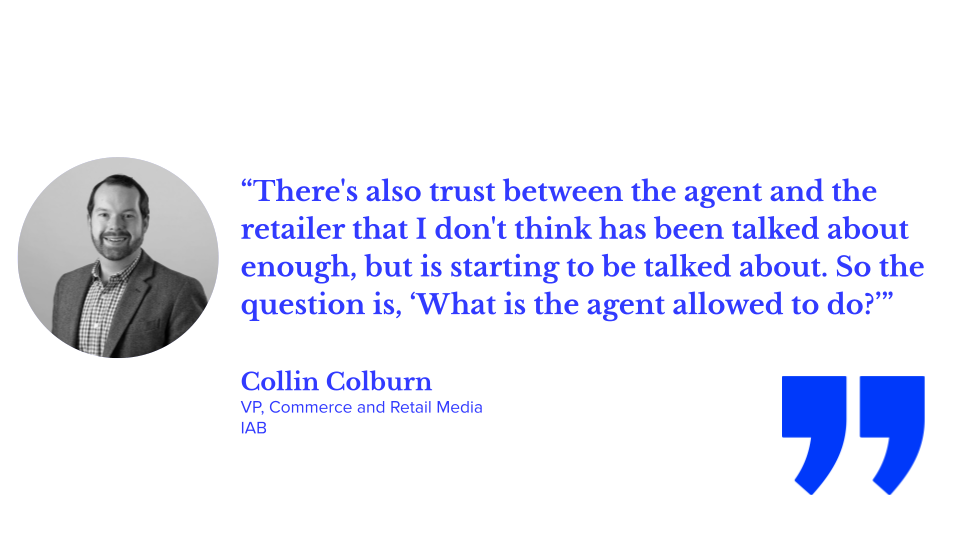
“On the trust piece, that's obviously where a lot of this friction happens,” Colburn says. “Forty-six percent of shoppers say they fully trust AI's recommendations and the information that's being given to them. So that means a majority don't yet fully trust AI for shopping.”
The AI trust gap goes both ways. It’s not only consumers who have AI trust issues, but retailers and brands do, too.
Colburn gives the example of a consumer shopping at Target.com.
“Has the user given them authorization to browse and search on their behalf?” he asks. “Have they given them the ability to add an item to a cart? Have they given them the ability to purchase? All this stuff matters, and it's a trust issue between agent and retailer because you have all these downstream retail use cases that are really dicey.”
For example, what happens if a shopping agent buys a scam product on a consumer’s behalf? Who’s culpable — the shopper or retailer?
This trust gap explains why agentic shopping hasn’t made the leap from the product and discovery stage to the transaction part of the funnel.
For agentic shopping to truly go mainstream, brands and retailers will need to create processes, workflows, and ecommerce governance that foster greater transparency and accountability.
The Future of Agentic Shopping
As the insights from these ecommerce leaders suggest, AI-powered commerce has arrived, but the agentic shopping era is still in its infancy.
Consumers are turning to AI tools for search and discovery, but they aren’t yet using shopping agents to orchestrate the buying process from end to end. Many brands also aren’t deploying agents that offer consumers this capability. Right now, they’re more focused on how to integrate AI into their backend digital shelf processes and are just beginning to focus on AEO and AI discoverability.
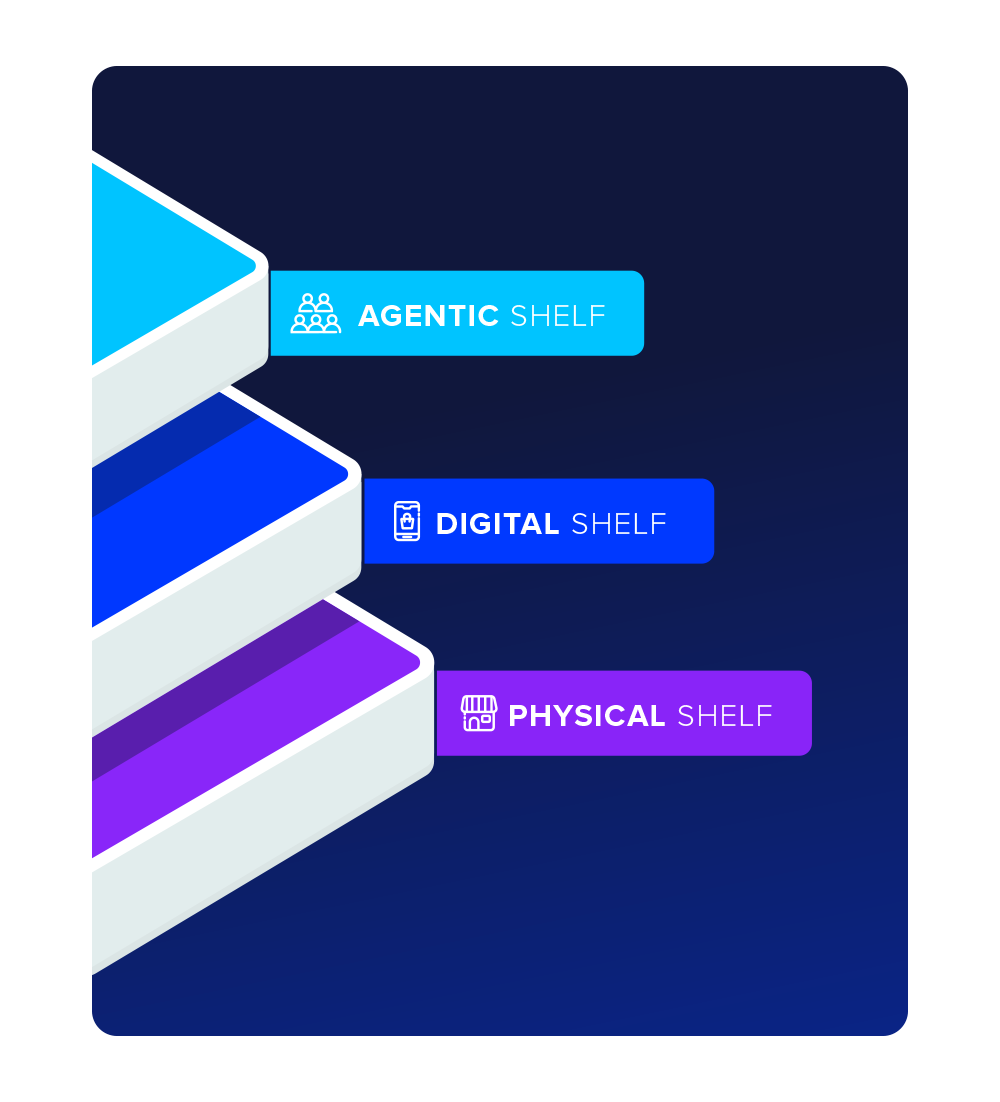
To win on the physical, digital, and now agentic shelves, brands will need to deliver the commerce experiences consumers want today while preparing for how they’ll shop tomorrow.
This preparation will also require an intelligence layer so human teams and AI agents work from the same facts. This new “centralized brain” approach will help brands move at machine speed while building consumer trust.
By prioritizing high-quality product data today, brands can embrace the long-term experimentation required to master omnichannel execution – no matter how the consumer chooses to shop.

The New Omnichannel: Winning the Digital Shelf and the Agentic Shelf
Download the whitepaper to learn more about how to execute for agentic commerce effectively and win across all three shelves.
DOWNLOAD NOW.svg)
