



The business-to-business (B2B) ecommerce market has seen steady growth over the past 10 years, with an estimated valuation of $36 trillion through 2026, according to data from the U.S. International Trade Administration.
The ITA also notes that since 2020, 90% of B2B companies have moved to ecommerce models that enable greater efficiency and visibility.
Today, 65% of industrial buyers order products online, as noted by DigitalCommerce360.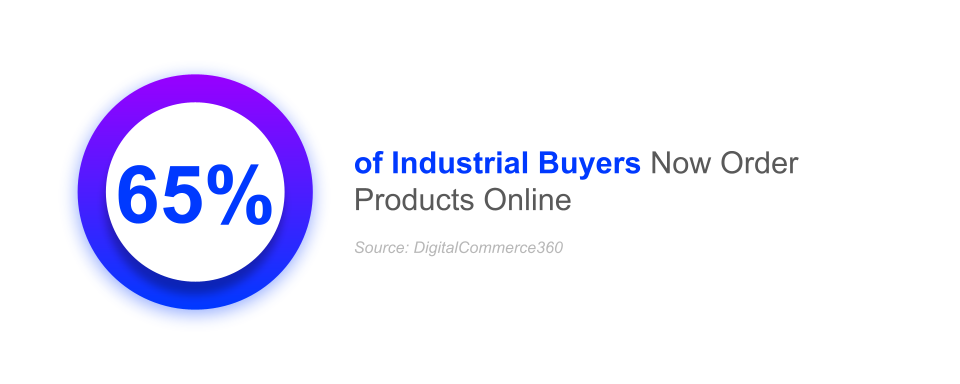
Speed and sight, however, aren’t enough if businesses aren’t buying. To capture — and keep — new customers, B2B brands must build trust.
Here’s what the experts and research have to say about building and bolstering trust with modern B2B ecommerce buyers.
Blurred Lines — How B2C Is Changing B2B
B2B buyers are customers when they’re not at work. They regularly interact with B2C brands through websites, social media pages, and mobile applications, and now expect the same experience in B2B sales.
As noted by Forbes, buyers want personalization and thoughtful journeys. While they’re buying on behalf of businesses, they want to be treated like individuals rather than revenue opportunities.
In practice, this blurs the line between B2C and B2B sales and marketing techniques. While distinctions remain — for example, a corporate buyer purchasing 10 pieces of heavy equipment has a different timeline and budget than the B2C consumer spending on a new pair of hiking shoes — both buyers want companies to value their time and effort.
When it comes to trust, these overlapped experiences are table stakes. No matter how great your product or how responsive your customer service, you won’t keep B2B clients coming back if the purchasing process is confusing, complex, or chaotic.
The Impact of Trust on B2B Sales
In B2B sales, trust is a critical revenue driver. More trust = more sales.
Research firm PwC found that among customers who trust brands, 46% spent more, and 28% paid a premium.
Backing this trend, data from Salsify’s “2026 Consumer Research” report highlights that 68% of buyers are willing to pay more for products from brands they trust.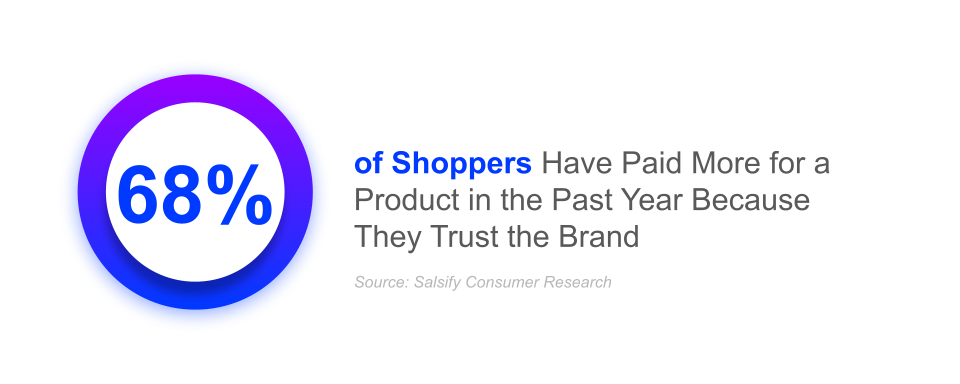
Trust is tied to repetition. Businesses need to do the same things over, and over, and over again to establish trust. Loss of trust, meanwhile, is often linked to a singular experience.
A Tale of Two-Year Loyalty and One Late Shipment
Consider a buyer who has come to rely on prompt shipping from a B2B ecommerce company. Over the course of two years, the customer has placed more than a dozen orders, each arriving on time or even ahead of schedule.
Their next order, however, is late. Despite a history of positive interactions, it’s a toss-up if the customer gives the company another chance or decides to cut their losses. While there’s no guarantee that buyers will stay loyal, B2B companies can limit the risk of churn by ensuring they’re up front about issues such as delivery delays or stockouts. The caveat? This communication can’t come after the fact: The sooner, the better for keeping trust intact.
When it comes to trust, there’s a simple rule: Break it, and customers won’t buy it.
What Builds Trust with Modern B2B Buyers: 3 Strategies for Success
Building trust requires a combination of intention and action. While many B2B companies understand the role of a better customer experience in creating trust, this knowledge isn’t effective in isolation.
Here are three strategies to help boost B2B trust.
1. Prioritize Product Experience Management (PXM)
Digital transformation sees B2B ecommerce companies storing products on digital shelves. These shelves appear on websites and mobile applications and contain content such as product images, videos, and descriptions. Buyers are looking for shelves that are clean, clear, and concise: What do products offer? How much do they cost? What sets them apart from the competition?
And just like traditional inventory, digital shelves need ongoing management. In first-generation ecommerce stores, this was accomplished through product information management (PIM), which focused on storing and governing product data.
PIM has now given way to PXM, which looks to optimize data for the customer experience. As noted by Rob Gonzalez, co-founder and chief strategy and innovation officer at Salsify, in a recent episode of the B2B eCommerce Show, “PXM starts at the shopper or buyer experience and works [its] way backwards.”
“PXM starts at the shopper or buyer experience and works [its] way backwards."
— Rob Gonzalez, Co-Founder and Chief Strategy and Innovation Officer, Salsify
Once companies understand what a great buyer experience looks like, they can build a digital shelf to match, in turn making it easier for customers to feel confident in purchasing decisions.
2. Mind the Generation Gap
As B2B buying evolves, so do buyers themselves.
Consider the growing impact of millennials. While their role in B2C ecommerce shifts is well-known — Salsify research found that 48% of millennials have purchased products online because a social media influencer recommended it, compared to just 28% of baby boomers and (surprisingly) 43% of Gen Zers — the role of millennials in B2B ecommerce is still evolving.
“More and more millennials don’t want to interact with somebody,” says Steve Max, director of global digital commerce strategy at TE Connectivity, in a recent Digital Shelf Institute (DSI) interview.
“... [Millennials] want to self-service digitally. And it's accelerating the depths of services they expect that for. In the past, you might get a customer so far digitally, you just have your product specs out there, but then you've got to call to get pricing availability. Millennials don't understand that. Why on earth would I have to call you for pricing? Why on earth won't you publish the price of your product on the website? And that's a fairly rapid shift, right? And so it's something, you know, manufacturers have to adjust to.”
— Steve Max, Director of Global Digital Commerce Strategy, TE Connectivity
While older buyers might be willing to call for pricing data, building trust among millennials and now Gen Z purchasers requires self-service sales options backed by complete digital transparency.
3. Implement Omnichannel Operations
B2B buyers want a seamless journey from interest to engagement to purchase. Omnichannel operations make this possible. In practice, this means ensuring that buyers can move from email to text to phone (if they’re not millennials) without having to start from scratch. It means consistent product, pricing, and availability data across every site and every app. Accomplish this, and your brand builds trust. Miss the mark, and trust is lost.
“Everyone talks about omnichannel, but it has to be consistent,” says Sean Donovan, digital channel manager for the Americas at MSA - The Safety Company, talking to Justin King in a recent interview for the DSI.
“... If [omnichannel isn't] consistent, then it falls apart. If you’ve got fantastic salespeople that are out there that just really know their stuff, but when I click on your website, it’s got limited data, it’s scary. I trust your sales guy, but I don’t trust your company.”
— Sean Donovan, Digital Channel Manager for the Americas, MSA - The Safety Company
B2B Trust: If You Build It, They Will Buy
Trust is a powerful motivator for B2B purchasing, but it’s not a renewable resource. Instead, companies must develop and implement strategies that improve the customer experience, address generational gaps, and deliver omnichannel options.

ON-DEMAND B2B ECOMMERCE WEBINAR
Discover how to build a best-of-breed B2B stack for your business, including tips for strategic goal setting and overcoming blockers.
WATCH NOW.svg)
