Shoppers are asking harder questions about where a product was made, what it's made of, and what happens to it when they're done with it. And increasingly, they're not willing to take a brand's word for it.
The Digital Product Passport (DPP) was designed exactly for this reason. It's becoming the biggest transformation in product data since the barcode, and is a regulation-backed requirement to prove, not just claim, that your products are what you say they are.
Brands getting “DPP ready” in 2026 are asking several questions to make sure they’re compliant:
- Which industries are affected by DPP?
- What are the timelines for DPP implementation?
- How do I format data for DPP compliance?'
If you're a global brand wondering how to actually structure your data, how to stay ahead of deadlines, and what Salsify is building to help, this guide is for you.
What Is a DPP and Why Should Brands Care Now?
A DPP is a digital record that travels with a product throughout its entire life, from the raw materials sourced to make it, through manufacturing, all the way to how it's eventually repaired, resold, or recycled. Think of it as one verifiable, tamper-resistant source of truth.
According to Salsify's “2026 Consumer Research,” 67% of shoppers say product quality and value influence whether they trust a brand, and 54% say durability and longevity are the top signals of product quality.
 It’s not simply that customers are curious about these details; they’re actually using them to decide what to buy. The DPP standardizes that trust at scale, and takes greenwashing off the table entirely.
The commercial case is just as compelling. According to MarketsandMarkets, the DPP market is forecast to grow from $185.9 million in 2024 to $1,780.5 million by 2030.
Which Brands Are the Most Impacted by DPPs?
As for who's affected: If your brand sells physical products in the EU, this applies to you, regardless of where you're headquartered.
The most immediately impacted sectors are apparel, textiles, footwear, electronics, batteries, construction materials, furniture, and chemicals.
What Are the Timelines for DPP Implementation?
Here are the dates you need to know.
- March 19, 2026: The European Commission's Joint Research Centre (JRC) published JRC145830, a definitive methodology for defining and prioritizing the data that must be included in DPPs under the Ecodesign for Sustainable Products Regulation (ESPR).
- July 19, 2026: The EU Central DPP Registry becomes operational as the central infrastructure that all products must be registered in before entering the EU market. On the same date, large companies will be prohibited from destroying unsold apparel, clothing accessories, and footwear under new ESPR measures.
- February 18, 2027: Mandatory DPP enforcement begins for industrial and EV batteries with a capacity over 2 kWh. Batteries are the first sector to face hard enforcement, and they'll serve as the model other industries follow.
- Mid-to-late 2027: Expected mandatory compliance for textiles, apparel, and footwear.
- 2028—2030: Selected product groups, including aluminium, tires, energy-related products, furniture, and ICT products, follow on a phased basis.
How Brands Are Structuring Their Data
Teams across multiple sectors are adapting their data models, structuring compliance information, and getting their supply chains properly mapped well ahead of enforcement dates.
Here's what that looks like in practice for two industries that will be impacted first.
-
Batteries. Teams need to track materials across multiple supplier tiers, including critical minerals like cobalt and lithium, right back to the source. On top of that, they're structuring data to capture carbon footprints, recycled content percentages, and real-time state-of-health performance metrics across the product's lifetime.
Regardless of sector, the brands that have started doing this now (and doing it well) share a few structural habits.
- They're centralizing all required DPP attributes in one place rather than scattering data across systems.
- They're maintaining full product histories that show any updates to the data over time.
- They’re also building role-based access control into their data architecture from the start, so sensitive commercial or manufacturing details don't end up publicly exposed when a DPP is scanned.
How Salsify Will Make Staying Compliant Easy
One of the most common questions brands are bringing to Salsify right now is some version of: "Where exactly does the DPP live in the platform?"
The short answer is, there's no single DPP template, and there shouldn't be.
A battery DPP and a textile DPP look almost nothing alike. One requires real-time state-of-health metrics and critical mineral provenance, while the other needs fiber composition down to the percentage and Tier 3 supply chain mapping.
A rigid, one-size module would either be too prescriptive for some categories or too shallow for others.
Excel With Flexibility
Instead, Salsify manages DPPs through flexible data schemas and custom properties, meaning brands can build the exact record structure their product category requires, import attributes, and layer in validation rules without rebuilding their core data architecture.
This flexibility is especially important given how the EU is rolling out DPP requirements. Rather than waiting for a single software release to unlock DPP functionality, Salsify's structure lets brands continuously add new properties and enforce new validation rules as requirements evolve.
Add an AI Layer You Can Trust
Salsify's Intelligence Suite adds another layer to this. AI-powered quality auditing and compliance checks are embedded directly into workflows, so brands can catch data gaps and instantly flag inconsistencies.
Here’s how Salsify will help you stay compliant:
- One home for all your DPP data. Salsify centralizes your product information in a single place, making it straightforward to add DPP-specific fields, pull in data from sustainability platforms, and keep everything audit-ready.
- Accuracy you can rely on. Built-in workflows and validation tools help you collect, review, and maintain consistent data across every team and supplier.
- Sharing that actually works at scale. Once your data is structured and verified in Salsify, you can quickly and easily share it with regulators, consumers, blockchain providers, and retail partners.
- Built to handle complexity. Different product categories have different DPP requirements. Salsify lets you add custom fields, configure category-specific workflows, and manage region-by-region compliance.
- Infrastructure that grows with the regulation. Because the European Commission is still issuing category-specific delegated acts, your DPP requirements will keep evolving. Salsify's flexible data architecture lets you add new fields, adapt workflows, and connect to new data sources as new requirements come out.
Salsify's role in the DPP ecosystem is as the central data control plane: the place where product data is structured, validated, and governed.
From there, Salsify partners with specialist blockchain and DPP infrastructure providers to handle downstream execution, routing verified data to physical carriers like QR codes and NFC tags, and making sure data can be cryptographically verified at EU customs borders.
If you're still figuring out where to start, how brands can prepare for the digital product passport is a good grounding in the foundational steps before getting into platform configuration.
4 Steps To Get DPP-Ready in 2026
With the EU registry going live in July and enforcement dates already on the calendar, the window to comfortably prepare is getting narrower by the day. Here are four practical steps to get there.
1. Audit Your Current Data Model
Pull together your existing product data and map it against the requirements for your specific category. You might find gaps, including missing supplier tiers, unstructured material data, incomplete provenance records, etc. Those gaps are where you should focus.
It's also worth remembering that strong DPP data starts with strong product data fundamentals. If your product pages aren't already built on accurate, complete, well-structured content, sort that out first.
2. Centralize Your Product Data Before July
The EU Central DPP Registry goes live on July 19, 2026. Products will need to be registered before they can be placed on the EU market, and to register, you’ll need structured, validated product data.
If your product information is scattered across multiple tools and teams, now is a good time to consolidate it into a single source of truth.
3. Build For Flexibility, Not a Fixed Ruleset
The current DPP requirements might (and probably will) evolve over time. The European Commission is still issuing delegated acts and defining sector-specific data requirements, and the current timelines are still subject to change.
Instead of building a rigid, static compliance solution that you’ll probably have to rebuild in 18 months, invest in an infrastructure that can absorb new properties, new validation rules, and new categories without a ground-up rebuild.
4. Map Your Supply Chain Tiers
DPP requirements will ask for provenance data that goes well beyond your immediate suppliers. Tier 3 (the raw material level) is where regulators want visibility, and it's also where most brands have the least data.
Start those supplier conversations now, as it takes longer to get the data the further upstream you need to go.
DPPs Are a Competitive Edge for Forward-Thinking Brands
The JRC blueprint is published, the EU Central DPP Registry goes live in July, and enforcement for EV batteries begins in February 2027. It’s happening.
But the introduction of DPPs isn’t just about compliance. Research from Certilogo found that 71% of consumers believe widespread DPP adoption will increase trust in brands, while 49% expect it to drive greater brand loyalty. Being compliant is another step toward being more credible. 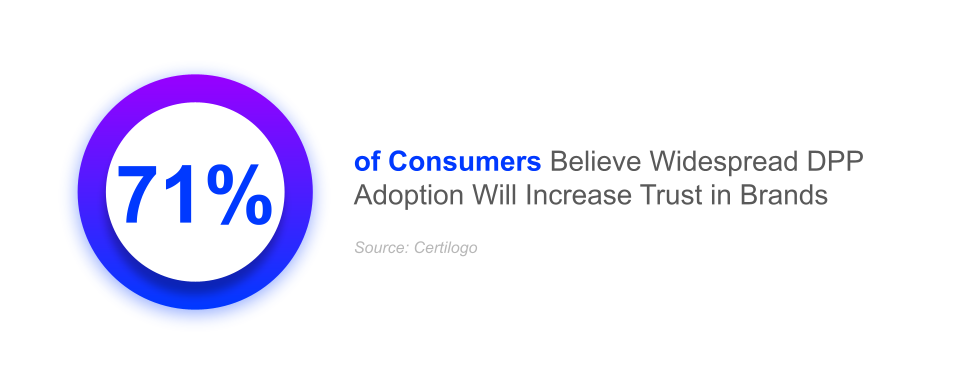
Yes, you’ll avoid penalties, but you’ll also build the kind of verifiable, transparent product story that today’s shoppers are actively looking for.
The infrastructure to do that is available now. See how Salsify is building for DPP compliance by watching the latest product update.




.svg)
