


Agentic commerce is on the rise. According to Morgan Stanley, nearly 25% of Americans make purchases using AI each month, while McKinsey & Company estimates that agentic commerce could drive $1 trillion in retail revenue by 2030.
If agentic-powered commerce sounds like something out of a sci-fi novel, you’re not far off the mark. Intelligent tools aren’t just helping customers find and select the products they want; they’re also placing orders and tracking shipments until packages arrive.
What does this mean for the future of retail? What steps can brands take to ensure they’re ready for the rapid adoption of sci-fi tech? And perhaps most importantly — how does this all work, anyway?
Robot Realities: What’s Under the Hood?
It’s time for a crash course in AI operations and decision-making.
AI is powered by machine learning (ML) algorithms. These algorithms enable AI frameworks to find patterns and then make predictions or decisions. Here’s a look at what’s under the hood.
1. The Purpose
AI models are purpose-built. For example, the purpose of agentic ecommerce tools is typically to help customers discover products based on supplied criteria such as product type, price range, brand, and availability.
2. The Data
Data is the primary resource of AI models. More data generally means better answers — as long as this data is accurate and timely. Low-quality data provides low-quality results.
3. The Training
Training is the basis of AI decision-making. Agentic tools are given a purpose, access to data, and are allowed to make mistakes. Over time, both accuracy and speed increase.
Consider an AI tool purpose-built to identify images of birds. It’s given access to text, image, and audio databases and told to find 100 bird pictures. On the first attempt, it selects 50 images of birds and 50 images of other animals that have some bird-like characteristics.
Human experts evaluate this data and provide feedback on both correct and incorrect answers. Then, the tool tries again. And again. And again, until correct results reach a predefined threshold.
4. The Guardrails
AI tools require guardrails to keep answers focused and prevent misuse. These guardrails may take the form of the datasets available for evaluation or the types of questions permitted.
5. The Outputs
Last but certainly not least are outputs. These are the answers to user queries and form the basis of continuous AI improvement. All outputs should be recorded, evaluated for accuracy, and used as feedback to enhance subsequent queries.
It’s also worth noting that current AI tools — from chatbots to ecommerce agents — fall into a subset known as “specific AI.” Also called narrow AI, specific AI excels at a single task. General AI, meanwhile, is a theoretical system that can handle any task with human-like intelligence.
Here, the standout word is “theoretical.” Even the most advanced agentic tools still have a very narrow scope. From a sci-fi perspective, this means that while they may take over the lion’s share of ecommerce shopping interactions, they’re nowhere near taking over the world.
The Evolution of AI and Your (Not So) Secret Agent
Chatbots were the first generation of AI ecommerce tools. They used a simple question/answer format underpinned by a limited knowledge base. In practice, this allowed users to ask questions such as “What are your store hours?” “Is X product in stock?”, or “Can you transfer me to a human agent?”
These bots didn’t learn — they simply retrieved data that already existed. Using keywords and phrases from human inputs, chatbots could quickly answer easy questions.
The Agentic Advantage
Agentic frameworks expand the functionality of AI in ecommerce. The term “agentic” means having the capacity to act independently and make decisions to reach a goal. As noted by MIT Sloan, AI agents “can execute multi-step plans, use external tools, and interact with digital environments to function as powerful components within large workflows.”
In ecommerce, the addition of agentic capabilities made it possible for AI-based applications to go beyond the content of user questions to incorporate context.
Consider a customer searching for a new set of golf clubs. After playing for a year, the hand-me-down clubs they own are no longer doing the job, and they have enough skill to warrant an upgrade. They have a budget in mind but no preference for brand.
One option for finding new clubs is visiting websites and sorting through hundreds or thousands of product choices. The other is using agentic ecommerce.
Not surprisingly, our golfer chooses the agentic option. They provide the agent with key details — they want a full set of clubs, they have a budget of $3,000, and they’ve been playing golf for a year. Using this data, the agent searches product display pages (PDPs) for potential matches, queries inventory planning tools for stock levels, and gathers shipping options.
Then, the agent presents its findings to the customer, typically broken out by price or brand. From here, the buyer can refine their query to add other qualifiers, remove specific product types, or ask for more details.
The agent goes to work again and returns new data, which eventually leads to a purchase. It also allows the agentic AI to shine — based on the data provided by the customer, the tool can go beyond what’s asked to include adjacent and relevant results. Since the tool knows our golfer has only been playing for a year, it might recommend a golf umbrella, a pair of entry-level golf shoes, or a pull cart.
The result is a win-win; the customer feels like they’re getting what they need, and the brand drives more sales.
How AI Already Impacts Buying Habits — And What Happens Next
AI is making inroads. According to Salsify’s “2026 Consumer Research” report, 22% of shoppers already use tools like ChatGPT for product recommendations.
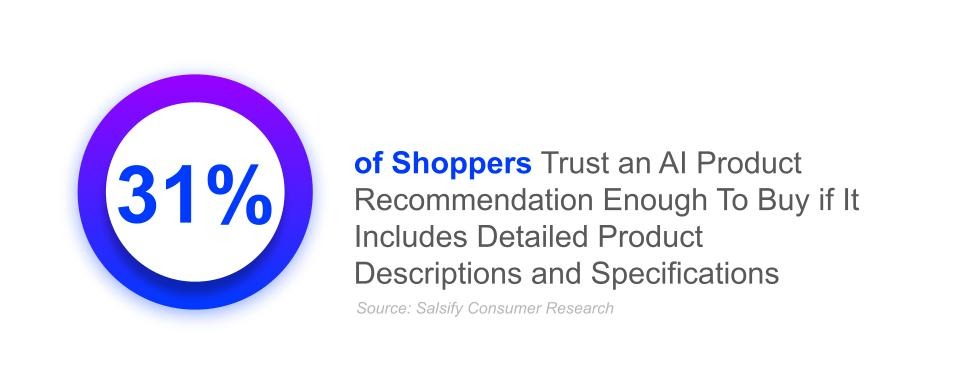
While just 14% of buyers say they trust AI tools and use them regularly, 31% of survey respondents said that detailed product descriptions and specifications increase their overall trust in agentic tools.
 If agents continue to prove themselves accurate and useful, what happens next is increased buyer trust. This shifts the awareness and consideration phases of the ecommerce funnel away from self-driven exploration and into the prompts of AI agents.
For businesses, this offers both an opportunity and a warning. The opportunity is the chance to build, test, and deploy agentic tools and brand websites that help buyers find what they want as quickly as possible. The warning is that as users become more comfortable with agentic answers, they won’t stick around if tools aren’t available.
In the best-case scenario, they use free tools such as ChatGPT or Claude, which may or may not send them to your site. In the not-so-great-case scenario, customers choose competitors that offer agentic options.
Ecommerce companies also need to consider the importance of product content. Detailed content is the primary driver of trust; as a result, PDPs must be timely, accurate, and reliable.
Finally, brands need to recognize that commerce now lives on three shelves: Physical, digital, and agentic. Unlike their physical and digital counterparts, these agentic shelves are effectively invisible. They don’t exist until customers ask for them, but buyers expect them to be accurate and complete.
Sage Advice From Sci-Fi Writer Douglas Adams: ‘DON’T PANIC’
With agentic commerce quickly becoming commonplace, concerns are easy to come by.
Thankfully, the “Hitchhiker’s Guide to the Galaxy” offers some sage advice. According to Douglas Adams, not only is it cheaper than the “older, more pedestrian” Encyclopedia Galactica, “it has the words DON’T PANIC inscribed in large, friendly letters on its cover.”
Just as Ford Prefect navigated the universe with a book (and towel) in hand, so too can brands find their footing in a world of agentic commerce — as long as they don’t panic.
Understanding how agentic-powered commerce works is the first step.
The second is anticipating what markets and buyers will do next.
The final piece of the puzzle is recognizing that while agentic systems may seem like the stuff of science fiction, they’re really just reasoning engines that have been tested and revised over and over and over again to produce reliable results.
Just like search engines, cloud computing, and data analytics solutions before them, AI agents are tools that can improve the customer experience and streamline the sales process.
.svg)
