

Search for “generative AI in ecommerce,” and the volume of articles, research, and predictions makes it clear: Brands can’t afford to ignore the impact of generative artificial intelligence (GenAI).
But GenAI isn’t a single product with a single purpose. From chatbots that boost customer engagement to content creation for marketing and sales, AI is making inroads across ecommerce operations.
Consider product search (and research): According to Salsify’s “2026 Consumer Research" report, AI search for ecommerce has grown in popularity, with 22% of shoppers turning to AI search tools like ChatGPT and Gemini for product research.
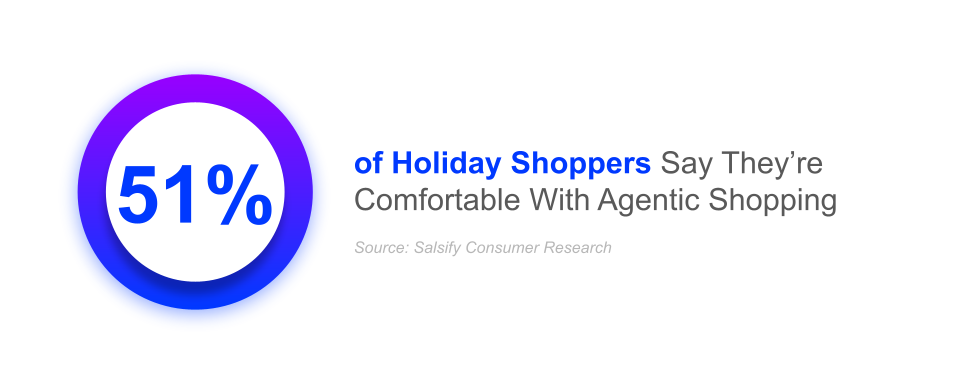
Additionally, more than half (51%) of holiday shoppers are comfortable with agentic shopping tools, which leverage GenAI capabilities and can take further action based on shopper preferences, according to Salsify's "2026 Holiday Pulse Report." This includes discovering, researching, and maybe someday, purchasing on shoppers' behalf.
If brands can capture customer interest with contextually relevant search results and sustain engagement through the research process, they’re better positioned to turn curiosity into conversion.
As noted by a recent study from “Eight Oh Two,” 37% of customers now start their searches with AI tools instead of search engines such as Google, and 62% say they “choose AI because it summarizes instantly, without the effort of scrolling through link-heavy SERPs”.
Here’s a look at how GenAI and agentic commerce are reshaping product search — and what it means for brands.
From Keywords to Context: GenAI and the Impact of Conversational Ecommerce Search
Traditional search is simple: Users input keywords and hope for the best. While search tools have gotten better at narrowing the scope of results — for example, a customer searching for “window cleaning services” should see local results first — searches remain hit-or-miss.
This sets the stage for diminishing search returns. If initial search terms don’t deliver relevant results, users typically try again. Each time the process repeats, however, frustration mounts.
While users can refine their queries if answers aren’t relevant or accurate, search engines don’t “remember” previous queries. Although they can provide commonly used keywords, they depend on user action to improve answers.
The result is a growing dissatisfaction with traditional search options. As noted by Search Engine Land:
-
54% of customers say they’re looking through more search results now than five years ago;
-
26% find it frustrating to comb through these results; and
-
22% struggle to find the right search terms.
To fix this frustration, GenAI tools turn search-and-response into a back-and-forth conversation that builds rapport and leads to the right answer. Instead of simply providing results, the AI framework asks for confirmation and clarity.
This allows users to provide more context that helps narrow the search. Each answer builds on the last, letting users follow their train of thought rather than starting from scratch each time.
Shelf-Help: Navigating the New Omnichannel
The physical shelf came first, and remains a key driver of conversion. Well-designed stores and well-stocked shelves make it easy for customers to find and purchase their preferred products.
Ecommerce created the digital shelf — websites, product detail pages (PDPs), and payment portals that streamline the process of discovery, engagement, and conversion.
GenAI is responsible for the newest omnichannel layer: the agentic shelf.
As noted by Salsify co-founder and chief strategy and innovation officer Rob Gonzalez in his “At The Whiteboard” video series, “the agentic shelf operates differently than the physical shelf or the digital shelf.”
The primary difference of agentic shelves is that the sales funnel collapses into a single step. Inquiries, advice, and recommendations all happen at once, meaning companies can’t afford to make a mistake.
The agentic shelf also offers an opportunity for startups who don’t have an established omnichannel presence. If they can get ahead of incumbents, they can cannibalize market share.
Gonzalez also notes that while the agentic shelf adds another layer, it doesn’t change total consumer spending.
“The total amount of consumer spend is more like a fixed pie,” he says. “Just because there’s a new way to shop doesn’t mean that you’re gonna buy more chocolate bars or buy more soda or buy more home improvement equipment. It just means that the consumers are spread across three shelves. It’s the same amount of dollars.”
What Agentic Shopping Tools Mean for Buyers — and Businesses
For buyers, GenAI searches offer better answers in less time. For businesses, next-generation searches come with the opportunity to stand out from the crowd — if they get AI right.
Here are five ways agentic AI is changing product search.
1. Searches Are Shifting From Keywords to Contextual Phrases
Keywords are general; phrases and context are specific. While GenAI returns relevant answers based on keywords, it can do even more with phrases.
Phrases provide both greater specificity and more context, allowing AI tools to search hundreds or thousands of sites and return any matching results. If no results are found, GenAI can suggest similar alternatives.
2. Searches Are Becoming More Personalized
AI-driven product searches also provide more personalized results.
With user permission, generative tools can include information about previous purchasing behavior and product preferences to deliver tailored results.
For example, a consumer who prefers to buy in bulk and pay the lowest price for products. With this data, AI tools can filter out results above a certain price threshold and seek out generic alternatives to brand-name options.
3. Searches Are Evolving To Include Multimedia
Another advantage of generative AI in ecommerce is the ability to go beyond text.
Using large language models (LLMs) and natural language processing (NLP) frameworks, GenAI can interpret other inputs such as voice, image, or video.
In practice, this could take the form of a product search chatbot that uses conversation to provide recommendations. Customers could also upload an image or video and ask AI to find a specific product shown or return examples of similar products.
4. Searches Are Leveraging Contextual Clues
Context is core to human experience. Conversations with other people are possible because human beings can simultaneously interpret content and context.
Sarcasm is a good example, such as a conversation between two locals who live in a winter city. On a particularly cold day, one says to the other, “Glad it warmed up out here.” Based on content alone, the statement is serious but inaccurate. Accounting for context, the sentence is a joke.
Evolving generative AI tools are capable of parsing context around content to provide more accurate search results. Consider a customer looking for a new pair of running shoes. This is the content. Using this information, AI could return a list of well-reviewed shoes.
Accounting for context changes the outcome. AI finds that this is the fifth time in a month the customer has asked for shoe recommendations. Paired with several less-than-favorable reviews they’ve left on footwear websites, it’s clear they’ve already tried and failed to find a good match.
As Salsify's whitepaper, "Mastering the Agentic Shelf: A PXM Playbook for AI-Fueled Growth," states: "The Agentic Shelf ... is built on context, a deeper, broader and more personalized array of use cases and data required to drive the exact right conversation."
Equipped with this contextual data, AI can eliminate shoes the customer has already viewed and use the information in their reviews to narrow the search field.
5. Searches Are Relying on Complete Product Data
In the same way that GenAI tools can parse customer preferences, they can analyze product pages for completeness and accuracy. As a result, high-quality PDPs are more likely to show up in AI-driven search results.
It’s also worth noting that 34% of shoppers have abandoned a sale due to incomplete or poorly written product details and that 38% have opted out of a purchase due to inconsistent product data across websites, according to Salsify’s “2026 Consumer Research” report.
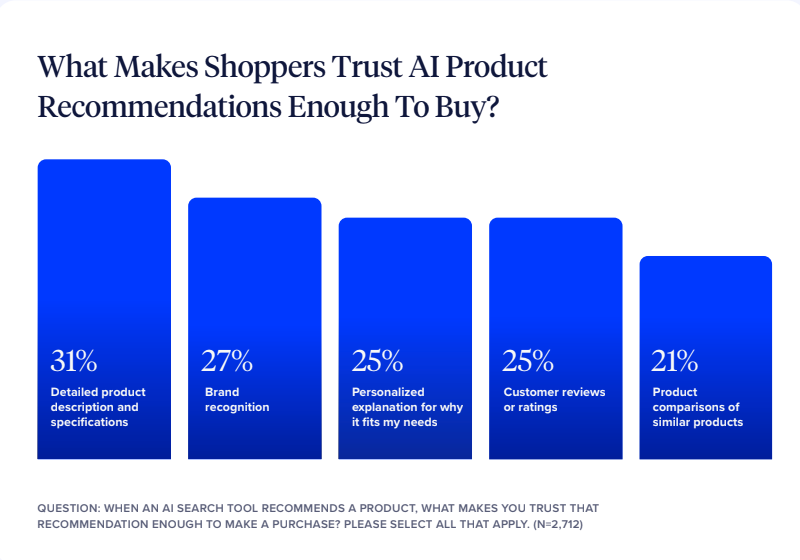
The report also found shoppers (31%) were most likely to trust AI recommendations if detailed product descriptions and specifications were provided.
Better PDPs increase the chances of getting noticed by GenAI search tools and reduce the risk of abandoned carts.
4 Best Practices for GenAI Success
While GenAI lays the foundation for the next generation of product search, it’s not a fire-and-forget function. Best practices, like those below, help improve agentic outcomes.
1. Establish Ground Truth for Your Brand To Drive Generative Engine Optimization (GEO)
Ground truth is real-world, measurable data. It may include product specifications related to materials and manufacturing processes, along with pricing, delivery, and returns data. While this information is subject to change over time, it’s quantitative and collectable.
Without ground truth, brands lack authority. And without authority, companies will fall short of GEO goals. For example, if brands want generative engines to use their content for AI-driven summaries and snippets, they must first establish ground truth that builds reliability.
To ensure current content matches ground truth, brands should regularly review publicly available data, compare it to verified sources, and make updates as necessary.
2. Track KPIs to Improve AI Product Search Results
Next, businesses need to track and measure key performance indicators (KPIs). These KPIs help brands understand how GenAI product search tools are being used and identify where there’s room for improvement.
Common KPIs include the total number of search tool interactions, the volume of AI-connected conversion rates, and the average order value (AOV) of sales that start with an AI product search.
3. Bridge the Gap Between Your PDP and the Shoppers' Consensus
AI agents don't just take your word for it. If your PDP says your products are waterproof but Redditers refute that claim, the AI agent will flag your data as unreliable and most likely won't recommend your brand.
You can improve the likelihood that agents will recommend your brand by:
-
Auditing your PDPs to ensure your information is correct;
-
Getting your products into the hands of influencers and key reviewers; and
-
Partnering with third-party experts to refresh your messaging.
4. Understand the Relationship Between Data Hygiene and Context
Accurate product searches depend on data hygiene. Information must be thoroughly inspected, vetted, and curated to ensure customers receive the most accurate and up-to-date version of PDPs and product details.
Robust data hygiene provides the “what” — the facts that consumers need to make an informed decision.
Context, meanwhile, answers a question: “So what?” Why do results matter to users? Why is one product better than another for a specific customer? Why does it make sense to buy from Store A rather than Store B?
Generative AI underpins contextual results to drive personalized answers. To build a context layer using AI, three components are required:
1. Mapping entities: AI must link a product’s solution to a human’s intention.
2. Building a library of context: Companies must map product attributes to specific human outcomes, environments, and comparative truths.
3. Implementing strategic chunking: Teams must break long-form content into standalone atomic facts, such as bulleted specs and FAQ blocks.
AI Search for Ecommerce Is the Future
GenAI in ecommerce is the future of accurate, personalized, and contextually relevant results. Make sure your brand is ready for the next generation of product searches across the agentic shelf.

Mastering the Agentic Shelf: A PXM Playbook for AI-Fueled Growth
Ready to go a layer deeper than GenAI? Master agentic: Learn how to free your teams from manual maintenance and start mastering the ground truth that fuels your brand’s authority.
DOWNLOAD NOW.svg)
