

Imagine walking into a store, staring at a shelf full of products, and flagging down an associate. You just dropped a small fortune on a high-tech washer and don’t want to fry the motor with the wrong laundry detergent — plus, you also have a history of rashes.
You need a plant-based, high-efficiency formula that protects your investment and won't break you out. The store associate doesn’t guess. They walk down the aisle, read the packaging, check the ingredients, and hand you the recommended item.
Now, consider you’re still looking for an eco-friendly detergent, but you’re shopping online. Swap that human associate for an AI shopping agent — like Amazon’s Alexa, Walmart’s Sparky, or Google’s Gemini.
When you ask an AI assistant that same conversational question, it can’t walk down a physical aisle. Instead, it sprints through a maze of backend data structures. If your product data is missing the specific attribute certifying it as "eco-friendly" and “good for sensitive skin,” your product won’t get recommended.
But where do you begin to make this maze navigable, and your brand a worthwhile prize at the end? Enter the new report and framework from Azoma and The Digital Shelf Institute (DSI), “The 5 C’s of Agentic Commerce: The New Industry Standard for The Era of Agentic Commerce.”
Agentic Commerce: Winning on the Digital Shelf
In 2026, the era of agentic commerce is quickly replacing the traditional search bar. To win the digital shelf today, you need an easy-to-follow blueprint like “The 5 C’s of Agentic Commerce.” Think of this five-step framework as the new industry standard for improving your product data and ensuring the robots actually recommend your products.
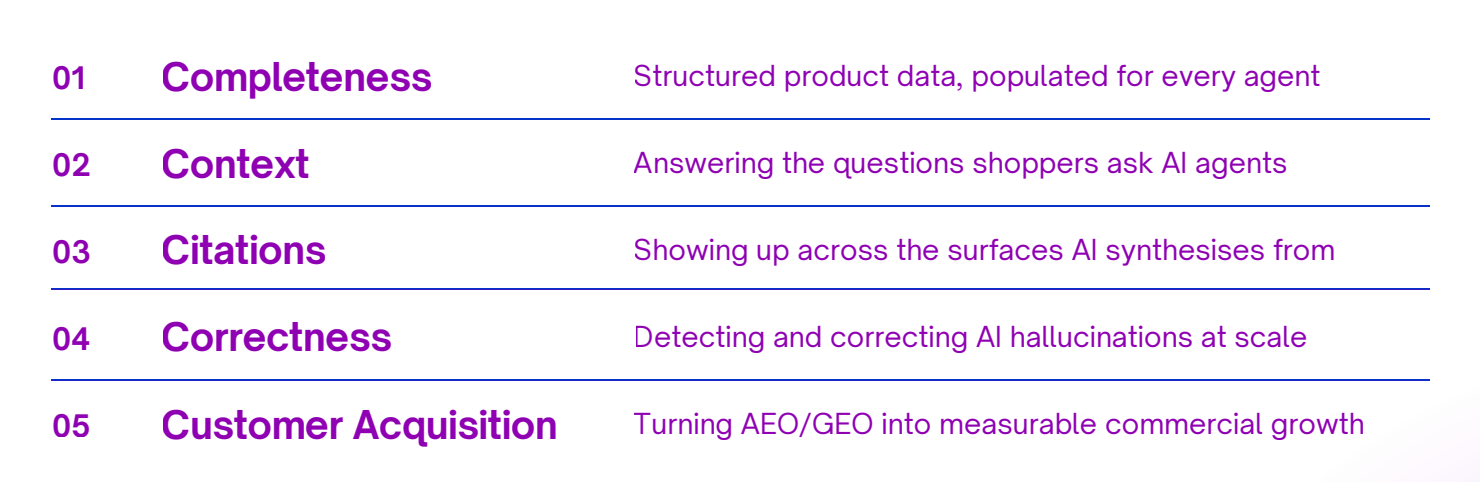
Image Source: The 5 C’s of Agentic Commerce
To help audit your strategy, this article breaks down each "C" with a quick reality check and a practical tip to improve your results — plus information on a webinar to help you tie it all together.
1. The First ‘C,’ Data Completeness
Completeness is the absolute prerequisite before anything else can be impacted. Data must be the first area of focus for all brands. You can have the most beautiful website, but gaps in your structured product data will severely limit what AI agents can find, evaluate, and recommend.
Agentic shoppers consume raw metadata — they don't skim your product detail page like a human shopper. Because of these differences, never leave an attribute blank; you want to update every technical specification.
- Did you know? AI assistants actively penalize listings with empty fields by filtering them out entirely during multi-attribute conversational queries.
- AI tip: Perform a gap analysis on your existing data. Treat "optional" retailer attributes as mandatory, particularly those related to allergens, sustainability certifications, and specific dimensions.
2. Conversational Context
Like in any good, friendly conversation, context is key. To win in agentic AI, your product listings must directly answer the questions that matter most for your category.
Unlike the old era of SEO keywords, AI agents operate on intent. They’re built to understand the deeper, conversational context behind natural human queries — not just match strings of text.
AI-enabled strategies include creating a dedicated context layer. This step allows brands to tell their unique product story while providing the right data to large language models (LLMs) to surface their products.
Consider this example: a shopper no longer types "waterproof tent 4 person." Instead, they ask situational questions about their specific environment, family size, travel preferences, and weather conditions. Your data must be rich enough to let the AI connect those dots.
- Did you know? Semantic search models evaluate the relationship between words. In plain English, this means an AI agent is smart enough to match a phrase like "need a sports shirt that won't irritate my skin" with a backend attribute labeled "hypoallergenic."
- AI tip: Review your customer service logs, Q&A sections, and review sites to find the actual phrases consumers use to describe your products, then integrate those terms into your backend data schema.
3. Cross-Channel Citations
Citations are how your brand shows up around the internet. Because AI agents often hallucinate, citations equal trust. Learn which ones carry the most weight for your brand, as AI agents search for consensus across your brand website, retail registries, and third-party review sites.
It’s important to note that no single department owns agentic commerce — just as no single function owns traditional ecommerce. Success requires alignment across sales, marketing, IT, social, and retail media. One idea is to establish a dedicated omnichannel team to unite stakeholders and coordinate your content, data, and campaigns.
- Did you know? AI engines heavily weigh third-party citations, user-generated content (UGC), and press mentions to validate claims made within your core product description.
- AI tip: Intentionally include your PR and corporate communications teams in your digital shelf strategy. Aligning their outreach ensures more high-quality, verifiable off-platform citations for the AI to find.
4. Data Correctness
Correctness requires continuous monitoring. AI can easily misrepresent your products and specifications even when your source content is completely accurate. The only way to know if your brand is being portrayed correctly is to check and act on what comes back.
Achieving correctness requires absolute data governance across your entire omnichannel ecosystem. Minimize hallucinations so AI accurately portrays your brand and product specifications.
- Did you know? Conflicting packaging dimensions or product counts across different retail sites can drop an AI's confidence score below the threshold required to trigger an automated purchase.
- AI tip: Set up routine, automated search queries against major LLMs and retail AI tools using your top branded search terms to flag and correct distorted product descriptions before they hurt sales.
5. Ecommerce Customer Acquisition
The final “C” — customer acquisition — is all about your commercial outcomes. The more your brand can bring multiple data sources together, the easier it will be to capture conversions.
Consider revisiting the methodology quarterly, as AI visibility data, retailer reporting, and measurement tooling continue to mature.
- Did you know? In agentic commerce, the winner-take-all dynamic can move quickly, as AI assistants typically recommend only one or two definitive items rather than a full page of options.
- AI tip: Link your AI visibility tracking directly to downstream share-of-voice metrics on key channels to measure how structured data improvements impact total conversion volume.
Moving Beyond Experimental AI Tactics
Many brands are trying new, isolated AI pilots without fixing the structural foundation. The reality is that the pace of change is faster than ever, meaning flashy copy won't save an incomplete data sheet.
Winning the agentic shelf requires moving past legacy, static product information management (PIM) solutions and treating product data as a high-speed intelligence layer. Establishing the “5 Cs” as your new strategy is your first step toward predictable omnichannel growth.

FROM DIGITAL SHELF TO DECISION SHELF: HOW BRANDS GET RECOMMENDED BY AI AGENTS
Check out Salsify's recent on-demand webinar, designed for digital commerce, ecommerce, product data, and retail media leaders preparing for the next phase of AI-driven commerce.
WATCH NOW.svg)
