Register Now
    Register Now

      What Is the Digital Shelf in the Omnichannel Era?

      Learn how the digital shelf remains deeply connected to the physical shelf, how both relate to the agentic shelf, and how organizations can win AI visibility and convert in the omnichannel era.
      The-New-Omnichannel-and-the-Three-Shelves-At-the-Whiteboard---thumbnail

      WHAT IS THE

      Physical Shelf

      The physical shelf includes in-store touchpoints and traditional brick-and-mortar shopping, including big-name, big-box retailers, boutiques, and pop-ups. Shoppers can browse, compare, and purchase products in person.

      WHAT IS THE

      Digital Shelf

      The digital shelf is a collection of diverse, rapidly evolving digital touchpoints where shoppers engage with brands and discover, research, and purchase products.

      WHAT IS THE

      Agentic Shelf

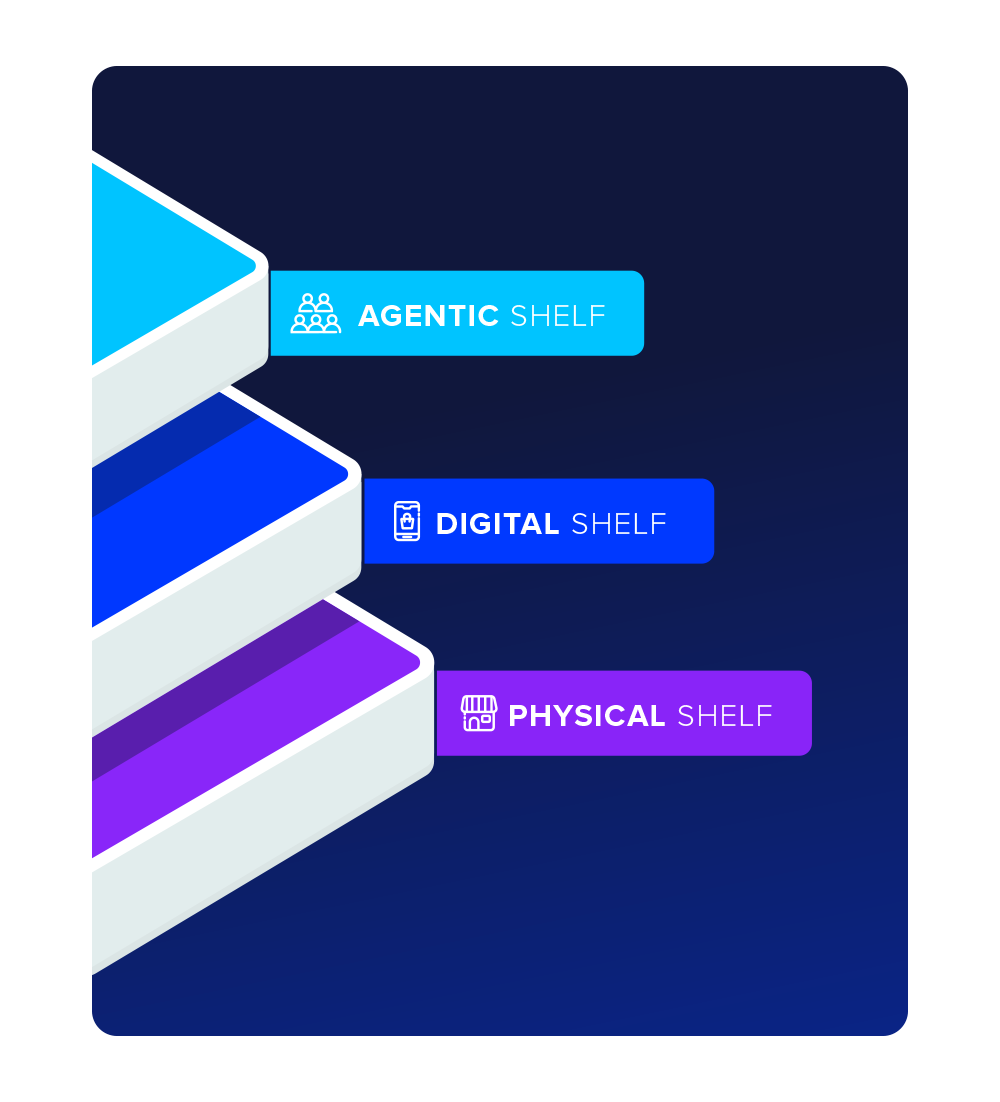
      The agentic shelf represents a digital shopping experience  — and touchpoints — where autonomous, AI-powered agents find, browse, and purchase products on behalf of a consumer.

      Buyers Shop Across 3 Interconnected Shelves: Physical, Digital, and Agentic — Are You Ready?

      Do You Deliver the Best Product Experiences Everywhere?

      Shoppers look for the products they need at the time and in the place that's most convenient for them — whether that’s walking inside a big-box retail store, scanning the pages of a direct-to-consumer (D2C) boutique site, scrolling on social media, or chatting with their AI agent of choice.

      Here’s what delivering the best product experiences means on the physical, digital, and agentic shelf:

      • The Physical Shelf: Requires thoughtful packaging, placement, and committed partnerships with retailers to keep your products in stock and top of mind. Brand consistency with your online presence is crucial to secure sales.

      • The Digital Shelf: Requires an omnichannel approach — compelling, complete product listings and high-quality visuals across all of your online touchpoints that match your in-store presence. Follow search engine optimization (SEO) and generative engine optimization (GEO) best practices to get surfaced in search results, social feeds, and generative AI for ecommerce.

      • The Agentic Shelf: Requires answer engine optimization (AEO), including further contextual information to answer increasingly specific queries about your products, such as detailed Q&As or FAQs, use cases, capabilities, compatibilities, who should use the product, and when. Metadata should include all required specifications, such as size, material, weight, etc., and product attributes should accurately map to human intentions via a brand's library of context.

      Salsify Agentic PXM Whitepaper -  agentic shelf image
      Rob Gonzalez takes the mainstage on Agentic Commerce Day at DSS 2026

      "When ecommerce and the digital shelf started becoming a thing, it's not like you could do that instead of physical retail. You had to do physical retail and [the] digital shelf. And now you've got to do the physical shelf, the digital shelf, and the agentic shelf."

      Rob Gonzalez Co-Founder and Chief Strategy and Innovation Officer, Salsify
      Webinar From Digital Shelf to Decision Shelf How Brands Get Recommended By AI Agents - Azoma
      ON-DEMAND WEBINAR
      From Digital Shelf to Decision Shelf: How Brands Get Recommended by AI Agents

      Watch our on-demand webinar for a practical discussion on how AI agents are shifting the path to purchase and what brands can do to prepare, be recommended, and convert.

      salsify_whitepaper_the_new_omnichannel_winning_the_digital_shelf_and_the_agentic_shelf_feature_image_1
      PLAYBOOK
      Mastering the Agentic Shelf: A PXM Playbook for AI-Fueled Growth

      You still need to rank for human shoppers and the digital shelf algorithm, but you should also ensure agents don’t have to guess about your product. Learn how to turn product data into conversion fuel across every endpoint.

      Are Your Go-to-Market Processes Flexible and Agile?

      The number of digital touchpoints that shoppers rely on continues to expand and change. You need a way to meet each new channel’s requirements and satisfy AI algorithms while quickly adapting to exceed shoppers’ expectations.

      Win sales by providing the most compelling, detailed, and up-to-date content across physical, digital, and agentic endpoints: Creative and compelling content on the front end to win the human shopper, and properly structured data on the back end so agents will choose your listings.

      Do You Incorporate the Digital Shelf Into Your In-Store Strategy?

      Digital screens influence the majority of all retail sales, as shoppers search and research online — or chat with AI agents — before buying in a store.

      Understand and communicate the influence the digital shelf has on your business. Maintain brand consistency and prioritize context for color and clarity (such as enhanced content, reviews, FAQs, etc.) to bring in new business.

      Does Your Organization Foster Cross-Functional Collaboration for Digital Shelf Success?

      Building and maintaining a fully optimized digital shelf takes years and requires collaboration across multiple areas of your business.

      Succeeding at the scale and speed required demands unprecedented levels of automation and cross-functional communication.

      Unify your organization with shared goals and measurements to scale your digital shelf strategy and drive efficiency.

      customer buying journey where shoppers discover new products salsify-1
      Blog Post Customer Buying Journey: Where Do Modern Shoppers Discover New Products and Brands?
      architecting growth
      Blog Post Architecting Growth: The New Fuel for Personalized Shopping Experiences
      A furniture store offers a product experience transformation, digital shelf strategy, product experience, ecommerce conversion, omnichannel commerce | Salsify
      Blog Post Product Experience Transformation: What This Means, and Examples for Achieving It
      Background image

      Are You an Omnichannel Organization?

      This quick assessment will help you uncover where you stand — from your product data and cross-functional collaboration to retail media and category management. You’ll receive tailored recommendations to strengthen your omnichannel strategy in just a few minutes.

      A Unified PXM Platform Can Help You Win on the Digital Shelf

      The most effective digital shelf strategy unifies the right people, the right process, and the right technology to drive a repeatable approach with optimum efficiency and maximum results. Salsify Product Experience Management (PXM) enables you to:

      • Centralize all product content, including inventory and pricing.

      • Connect the right product experience to the right channel at the right time.

      • Automate the process so teams complete work as efficiently as possible.

      Learn how Salsify PXM — and the global network of Salsify partners — is the best solution to enable your PXM strategy at speed and scale.

      Connect With Other Leaders Through the Digital Shelf Institute

      The rapid pace of change on the digital shelf requires effective strategies, agile operations, new partnerships, and continuous improvement in every channel — both online and off.


      Why is the digital shelf important for selling products?

      According to research by Forrester, 70% of U.S. retail sales will be digitally influenced by 2027 — the majority of shoppers search and research online, even if they ultimately choose to purchase in-store.

      This occurs in the phenomenon known as “webrooming,” wherein shoppers browse a product online before purchasing in a physical store. According to Salsify’s “2026 Consumer Research” report, more than two-thirds (67%) of shoppers webroom, and more than half (53%) showroom, or browse a product in a physical store before purchasing it online.

      Having a strong digital shelf presence translates into competitive performance in the new omnichannel era of shopping — as the buyer’s journey is no longer linear. Brands that want to win must be found on a wide array of touchpoints across physical, digital, and agentic shelves, offering complete, compelling, and creative product listings and experiences.

      What’s the difference between selling on the digital shelf and the agentic shelf?

      The agentic shelf is online and digital in nature; the digital shelf fuels the agentic shelf. Agentic shopping — or shopping that occurs when a shopper consults with an autonomous AI agent to find, research, or purchase products happens on the agentic shelf.

      This is different than a pure ecommerce, online selling, or shopping experience of the digital shelf. Selling on the digital shelf requires SEO and some GEO, while selling on the agentic shelf requires SEO, GEO, and AEO for agents to find and recommend your product listings to shoppers.

      On the agentic shelf, a shopper will interact with an AI agent or AI shopping assistant at some point during their buying journey — this doesn't always happen on the digital shelf.

      How can I improve my product's digital shelf presence?

      You can improve your digital shelf presence by establishing a single source of truth for all of your product data, including visuals and detailed product specifications in the correct format and language for all your target markets.

      This source of truth should connect seamlessly across all your desired touchpoints — physical and digital — with minimal errors and a digital shelf analytics tool that enables real-time troubleshooting so you don’t jeopardize sales due to incorrect or inconsistent data.

      Adding below-the-fold, A+ Content, or enhanced content complete with videos, FAQs, comparison charts, etc., to create full product experiences — not just flat product pages — can also help drive further conversions.

      Finally, you should aim to employ automated systems to help regularly optimize content across all your product detail page (PDP) listings — not just top performers — to meet the needs of diverse shoppers, adapt with the seasons, and be indexed and surfaced in AI recommendations. 

      What are the best digital shelf analytics tools?

      The best digital shelf analytics tools track, measure, and optimize live product content performance across ecommerce channels. Tools should connect to a brand’s single source of truth and content syndication methods — and provide real-time market data — so brands can fix inaccuracies, improve search visibility, and increase digital shelf conversion rates.

      Will the agentic shelf replace the digital shelf or other forms of shopping?

      No, the agentic shelf is another place where shopping happens. AI agents can find, research, and purchase products for shoppers, but not all shoppers will choose to shop this way. Just as the digital shelf became an extension of the physical shelf, the agentic shelf is the same. All three shelves work in tandem to provide shoppers with products and answers across an increasingly complex, interconnected array of touchpoints.

      Can agentic shelf technology help small businesses?

      Agentic shelf technology — in other words, autonomous AI agents that shoppers can have conversations with to find, research, and purchase products — is a prime example of how small or new businesses can gain an edge over bigger, legacy competitors. Ensuring content is compelling, clear, and creative, and includes high-quality visuals or enhanced content like videos, comparison charts, and so on, will satisfy SEO and GEO requirements. Ensuring back-end data (i.e., metadata), such as detailed specifications like color, size, fabric or materials, compatibility with other products, who the product is best for, and so on, is present and accurate will help satisfy the contextual answers AI agents are looking for.

      These agents are not looking for a brand’s reputation or size; rather, they’re looking for content with AEO — accurate, complete answers with metadata to match that explain how a shopper’s needs will be met and why that product is the best fit for them; for example, an answer to “best wide running shoes for women to run on the beach.”