Overview: Does AI Mean That Personalization is Finally Here?
Hi. I'm Rob with Salsify, and we are back at the whiteboard today to talk about personalization. Now personalization in ecommerce has been a holy grail for a long time. Amazon and others are trying to give you deals based on your shopping. Right? You know, they're gonna say, oh, you know, we noticed that you were shopping for one thing. Let me offer you other things around there, and so on and so forth.
But I would say that most of us experience the personalization attempt by ecommerce retailers to be maybe, I don't know, missing the mark a little bit. I mean, we've all had this experience, the old joke, because you buy one toilet seat off of Amazon and then you're just getting recommendations for toilet seats all day long. Like, how many toilet seats do you really want? What do they actually know about you?
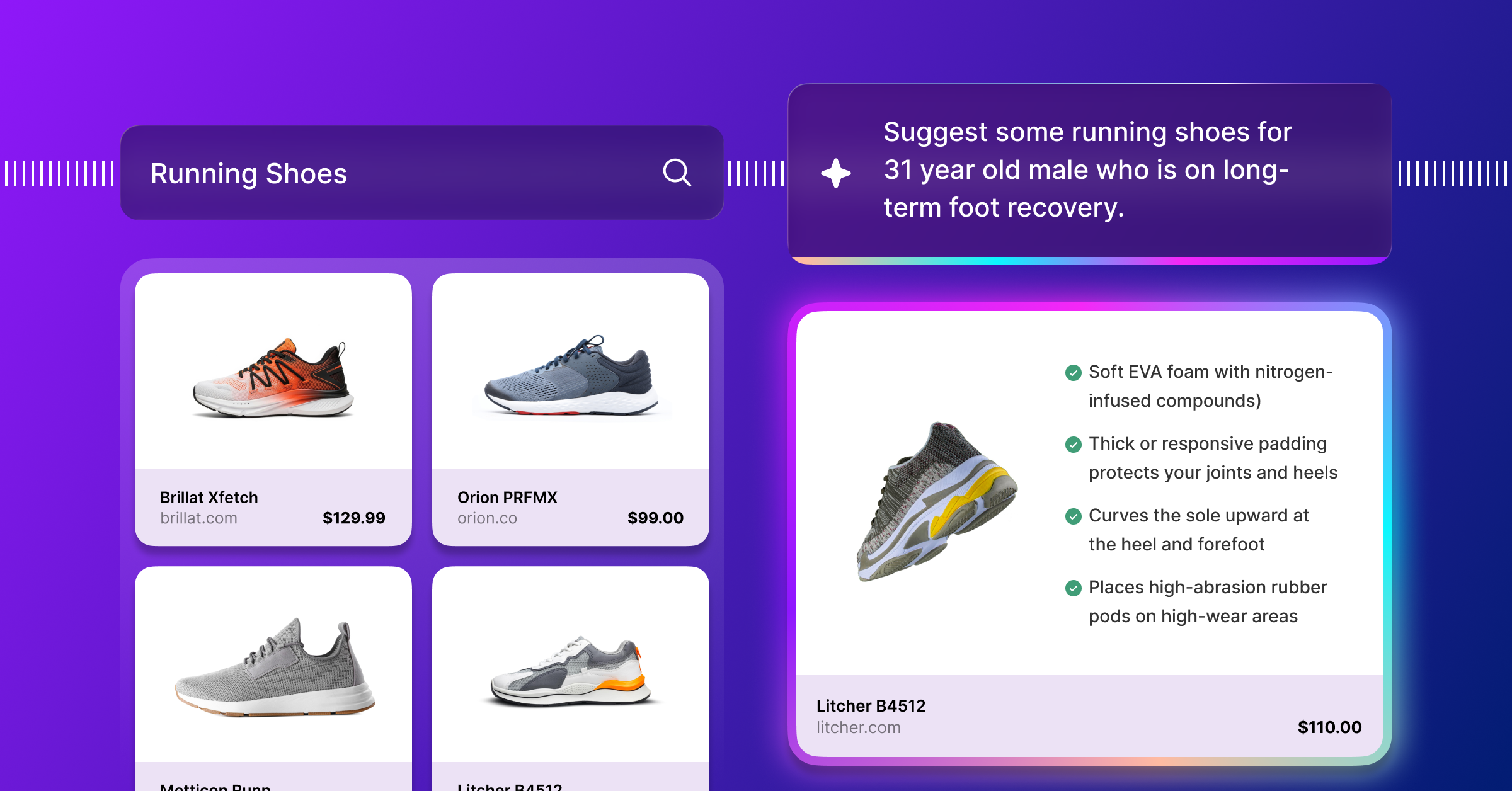
Are they doing a good job? With AI, there's an opportunity to get beyond this, to be more intelligent about your offers. AI has the potential to actually be a personalized shopping assistant that knows about you, knows your context, can bring data in from lots of places, can actually make personalization happen. And people are working on this because the return on getting personalization right is crazy.
Traffic. When we know that we give personalized offers to people that are relevant, people are more likely to click on them to get to the product detail page. When they get to the product detail pages, because the offers are relevant to them, they're more likely to add them to the cart. If you're spending money on personalized offers, therefore, the returns are gonna be stronger.
The basket size and the tax rate of products to the overall shopping experience is higher. All of this, you know, is money right there. Or, you know, in the EU. Right?
So in returns, go down because you're giving them stuff that's relevant to them.
However, this is hard to do. I don't expect large language models all of a sudden to solve the personalization issues for ecommerce companies, for suppliers, anybody overnight. And the reason is because, you know, companies like Amazon or a Walmart or any retailer that you're talking about over your own business have impediments to driving really true personalized shopping at scale.
One of them is simply the data silos.
Information about you, your shopping history, the shopping histories of others like you, and so on and so forth. They tend to sit in different places simply because, you know, that's how operationally they were set up.
If you're creating personalized offers at scale, you wanna have personalized copy, maybe personalized imagery, language relevant to the actual shopper. LLMs can do that, but can they do that at scale? Can they do that in scale in a way that a retailer will trust? For example, are they gonna make things up? Are they gonna say false things? Retailers are already driving conversational shopping with on their sites.
But, you know, branded manufacturers and product detail pages and media offers and all this sort of stuff isn't exactly done. The creativity at scale isn't quite happening yet. Real time performance is a concern. Anybody who uses AI and large language models, you can literally see the text being generated in real time.
Right? It's not exactly the hundred millisecond snappy page load responses that people are used to in ecommerce. So you can imagine if you're generating all the offers and you're generating the copy and you're generating all these things, you can't really, it's hard to do it in real time. The systems don't really work in real time, so it changes the ecommerce shopping experience.
And then, of course, if you've got, you know, creative and you've got IT and data silos and you've got people that are like the site merchants doing the optimization, they're all in different parts of the organization. So how do you coordinate all these people together to drive a really personalized shopping experience? I think that this is gonna happen, but there's challenges in getting there. And I think that if underfunded media, like channel one is saying that they can produce personalized newscasts for everyone who's watching channel one, I think if they're experimenting with this, it's gonna happen.
Everyone's gonna do it. It's quite possible that not too far in the future, you know, you go to an Amazon and I go to an Amazon and we see different things even for the same products, different images, different product titles, different feature bullets. The search experience is different. It guides us to products that are maybe more relevant to me versus you.
And that is a better experience for everybody,
and it makes more money for Amazon, and it makes more money for all the suppliers of Amazon. So what we're gonna do in the shorts going forward in this series is talk about each of those bottlenecks and how, as an industry, we could maybe push through.
Part I: Does AI Mean That Personalization is Finally Here?
I'm Rob with Salsify. We're back at the whiteboard. This is part of our personalization at scale series. If you haven't watched the overview, I recommend you do that.
Today, we are going to be jumping into two of the bottlenecks we talked about: Data silos and creativity at scale. These are two of the things that we need as an industry to work through in order to drive really, truly personalized shopping experiences on the digital shelf. The first one, data silos. Any large enterprise is familiar with this.
You've got giant enterprise systems, your CRMs, your ERPs, marketing automation systems, web analytics, customer service data, who knows what the hell else is lurking in your IT systems.
Large companies in the last decade have spent a lot of time trying to bring together data from across these systems, often into something like a data lake, and the data lakes have gotten quite large. And so they've done some of the basic work in order to bring this stuff together.
I will say, though, the information in the data lake, it's used for reporting. It's used for talking about what has happened yesterday, and that's incredibly valuable. It's often not actioned, and it's certainly not predictably actioned in real time. So you get information all in the data lake, but people are often struggling to get it out to a system that can use it to change the experiences of shopping. So here, I think the major bottleneck is action based on the integrated data in a lot of cases. In some cases, you still haven't integrated this data.
That's the big project. I predict on a go forward basis, especially if you include things like, from the web analytics, every single click that your shoppers have clicked on your site that you're bringing it into the data lake in order to predict what they might be shopping for next. The amount of data that's going into these data lakes is going to explode as folks are looking at this. The next silo is creative at scale.
This is the images, the text, the product title, how you describe it, all of this stuff. A lot of branded manufacturers, the largest in the world, the Nestles, the Newells, the Unilevers, they're talking about how AI is helping drive desire at scale, right, or ramps up content creation with AI powered digital twins or bolsters content creation with Gen AI. A lot of major companies are using AI to generate a lot more content. I think in this Unilever study, they were talking about dozens and dozens of images per product for a product launch as opposed to what they were doing before, which was mostly product photography in a relatively small number of images for the digital shelf.
If you're talking about personalized product imagery, you're not just talking about necessarily dozens of images. You're talking about, I don't know, thousands of images, images that are tailored to lots of different micro demographics, you know, in the future, maybe tailored to individual shoppers themselves. Right? And so this personalization is just starting down this road. Companies are just starting to get used to generating a lot more volume of content than they used to.
It's not yet personalized. I think that getting to the personalized level is gonna produce a volume that's gonna challenge storage systems, and critically, it's not yet expressed through the supply chain. There's no way for these companies to take fifty images and get all fifty images to Amazon, for example, for a single product. Amazon doesn't accept fifty images on a single product.
Walmart doesn't accept fifty images on a single product, and so on and so forth. So here, we've got a generation problem, we've got a storage problem, and we have a communication problem, and that's even before we get to the display problem of actually deciding which image, which text to show to the shopper when they're actually shopping. So I think that the data silo issue that we talked about today is significant, but in the last decade, have been making progress on it. And I think the creative issue is even more of an impediment, and it's gonna take longer to work out. Thank you.
Part II: Does AI Mean That Personalization is Finally Here?
Hi, I'm Rob from Salsify. We're back at the whiteboard. This is part of our ongoing personalization series. If you haven't seen the overview, I recommend you do that. Today, we're talking about two of the major blockers towards real time ecommerce personalization in the age of AI. The two we're talking about are performance and strategy.
All right, both of these are significant. So starting with real time performance, in the 2000s, I worked for an ecommerce search company called Endeca Technologies. Endeca powered the search for Walmart, Target, Home Depot, others. And one of the things that we knew is that every hundred milliseconds of additional load time on an ecommerce page changed the conversion rate.
A hundred milliseconds, right? You'd think that it wouldn't matter for humans, but man, humans are impatient. So the latency that it takes to return an ecommerce experience does matter. People will close their browser, they'll go somewhere else, they get frustrated.
Right now, when you use generative AI tools that are just, you're seeing them think on the fly, you're actually literally seeing the text flow through the screen, We're not talking, like, hundreds of milliseconds in order to get a response back. We're talking about way more. So if you're looking to generate content on the fly for a personalized shopping experience and you're looking at what the speed is of Gen AI today, it's not gonna work. You gotta do something else.
You probably need to cash everything ahead of time. You know? So if you're a retailer, can think at the limit, I am gonna create a different website almost for every single shopper who might visit my website. In the US, maybe a couple hundred million versions of the website.
You don't necessarily have to go all that way. Maybe you could create five hundred or one thousand micro demographics, and each of those could be a cash different experience. Maybe you only do it for the top products. But, I mean, you see what I'm talking about here.
You kind, of in order to come over the latency issues, you'd have to pre-generate a lot of additional content, and that is gonna be a huge challenge on the scalability of your infrastructure. Because now instead of serving one version of content, you might be hosting across all of your storage a whole different set of content, and then on the fly, the system is gonna have to decide which of them it's gonna be showing to each individual shopper. That's going to be a challenge. We don't really have the infrastructure to do that today.
It's also going to be a challenge to improve over time. With your current ecommerce technologies, you can AB test. Is this image better? Is that image better?
What if I split these two categories apart into four? What if I combine two categories into one? What if I add additional attributes on the page? You can kinda test an AB testing all kinds of different little things, and that works because you're getting a volume of views on each of the A and the B versions of what you're testing.
If, however, you've got tons of different versions of a product already that you're showing people, that really complicates the AB testing and what you're able to test and the statistics behind it. So how you optimize them over time is a whole other problem. And so these two things kind of conflict on some basic level in terms of long term improvement, and finding a balance between those things, I think, is going to be tough for companies. Moving on, I think the strategic question, though, is the biggest one.
This is going to touch almost every part of an organization to do ecommerce at scale. We talked about data silos, for example, in another video. We've talked about bringing all of the different processes together.
I think that this is going to be a huge issue.
Once you decide to do personalization, how many different departments have to be involved? How many different systems from those departments have to be involved? How much investment are you going to need?
Even if you want to do it, there's, you know, the lawyers are gonna have to get involved, which is not usual for ecommerce because different regions have very different rules and regulations around what personalized data you can even use. So I think in the US, for example, you're gonna be able to go further down the truly personalized shopping experience route. In Europe, you're not gonna be able to go as far. Right? And even within the US, you've got different states that are kind of testing out different privacy laws over time, and so who knows where this is going to land.
I also think that there's questions around how you actually want to do personalization. So I've talked to very large retailers who want to do what I said at first, which is create almost a totally different site experience for every single shopper.
That's a big vision, right? And that's a very specific vision. I've talked to other retailers that say, Well, know, used to have a couple or a few different demographics that we would market to. Now we want to get a thousand demographics that are tighter. That's another kind of vision and another kind of strategy. There's a spectrum of personalization, and just deciding what you're going to go on and sticking with it for a long time is going to require organizational decisions.
There's also, how do you bring all this stuff together? We talked about on the previous slide that organization bottlenecks are going be an issue.
Think about how long we've been trying to figure out where ecommerce even fits within a manufacturing company.
You look at the large ecommerce retailers, they have site merchants, then they don't have site merchants, they merge the site merchant team into the regular merchant team. It's just the fact that you're selling in stores and you're selling online and they're both completely different people process technology stacks, but you kind of want them to work together.
That's still something that I don't think every single company has nailed. And now all of a sudden, you want to add this additional really high complicated goal of personalization on top of it. Man, I don't know. This is going to really stress how companies organize.
Man, companies are already struggling to hire people that are good at digital, let alone really good at AI, let alone You know what I mean? So finding people that can do all this sort of stuff is gonna be really, really hard. So for, of all of the bottlenecks, I think that this is the toughest one. The organizational strategy and the organizational execution complexity. Even if you solve the data silos, even if you solve the real time performance, even if you solve creativity at scale, you're still going to have the organizational issues on making it all real. So personally, I think it's going to be quite a while before we see truly personalized shopping at scale in an ecommerce experience. What I think is going to happen is you're going to see the big guys kind of chip away at this problem a little bit over time, and it'll open up opportunities for manufacturers to take part in the early stages of personalization as they go.
I hope this has been useful. Thank you.



.svg)
